Last night’s State of the Union address wasn’t just another speech — it set a record. At 108 minutes, it’s now the longest ever delivered to a joint session of Congress, surpassing the previous record by nearly 20 minutes.
On the surface, it looked like a detailed policy rundown — economy, immigration, foreign affairs — but the sheer length and theatricality of the event say something deeper about where power sits in Washington today.
From Constitutional Ritual to Political Marathon
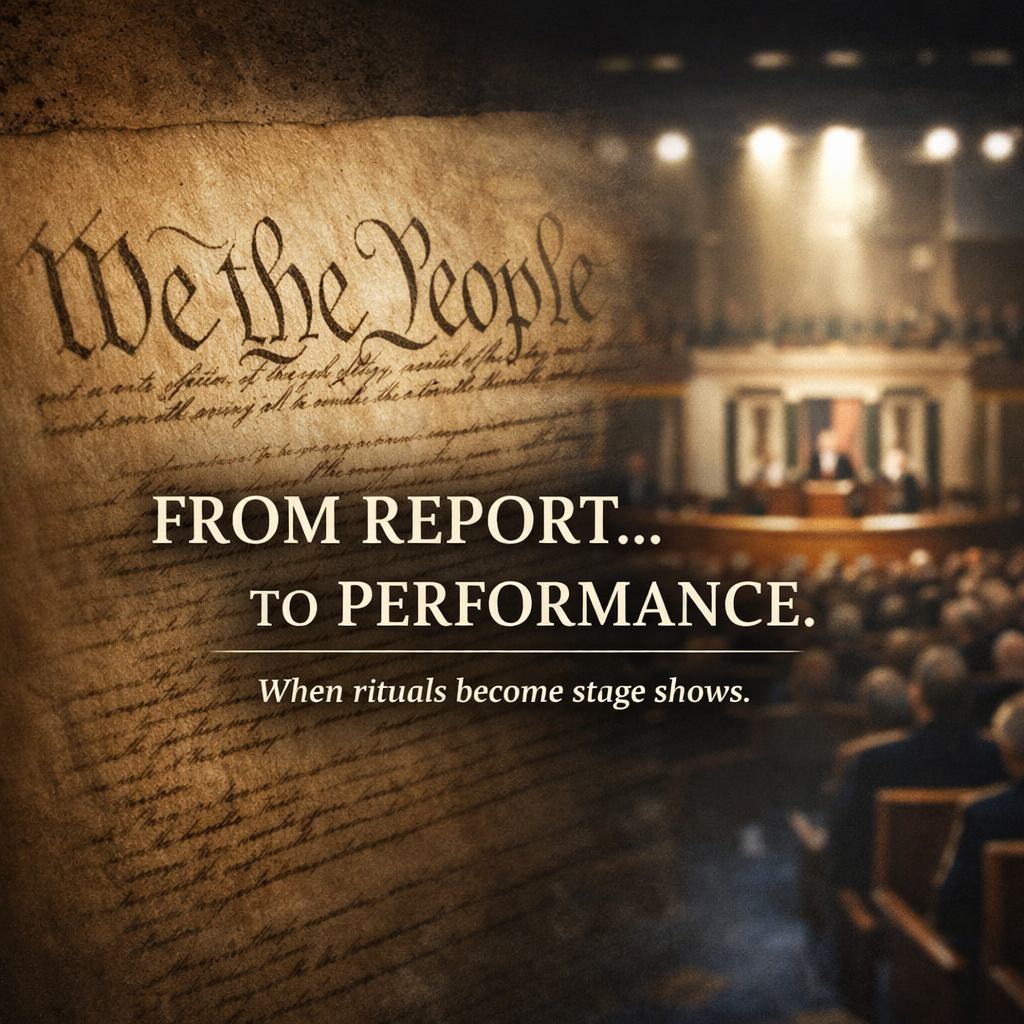
The State of the Union isn’t just a speech. It’s a constitutional ritual. The Founders designed it as an annual report to Congress — a chance for the president to inform the legislature about the state of the nation, and for lawmakers to deliberate and respond.
But when a president uses the time almost as a prime-time broadcast, stretching well beyond a substantive update, it raises the question: Has this inherently legislative engagement shifted into executive spectacle?
What once may have been a sober accounting to the people’s representatives has become in practice something closer to a campaign event with all the trimmings.
What Longer Really Means
A long address doesn’t necessarily equate to more substance. In many respects, it reflects a broader trend:
👉 Centralization of messaging: Instead of working through legislative channels or public hearings, the executive branch is turning to its own pulpit to define national narratives and priorities in one extended burst.
👉 Performance over deliberation: The President’s nearly two-hour delivery doubles as a demonstration of command — not just of policy achievements, but of political stage dominance.
👉 Blurring of roles: The State of the Union was designed to inform Congress. Now it often serves as a mega-address to the public, bypassing the back-and-forth of legitimate legislative discussion.
These aren’t minor shifts — they reflect how the balance between branches of government can subtly change over time, without formal amendments or explicit declarations.
Why It Matters to Civic Health
This development isn’t about liking or disliking a particular leader. It’s about the architecture of our system of government.
The Constitution envisioned checks and balances, with each branch holding distinct functions:
- Legislative: makes laws
- Executive: enforces laws
- Judicial: interprets laws
The State of the Union sits at the intersection — it’s a moment when the executive reports to the legislature. When that moment becomes a theatrical endurance test, it suggests the relationship has changed from mutual accountability to something more one-sided.
It’s also worth noting that independent evaluations found that much of the speech included inflated or misleading claims about the economy and national conditions. Whether true or not, the spectacle of a marathon address highlights how political messaging can eclipse substantive civic discourse.
A Ritual Evolving Into Something Else
This isn’t just a reflection on one speech. It’s part of a broader trend:
- Leaders increasingly turn public rituals into political platforms.
- Institutional checks remain — the judiciary, for instance, recently acted to limit unilateral executive tariff authority.
- Yet the way powers are exercised and communicated has shifted.
Constitutional design assumes friction — debate, back-and-forth, deliberation. Sustained speeches that transform reporting into performance may not break laws, but they recast roles and reshape expectations of how the branches interact.
A Quiet Shift With Big Implications
Recording the longest State of the Union isn’t just trivia — it highlights how the executive branch frames itself in relation to the rest of the government. And for the millions who care about the health of American civic life, it raises this question:
When the constitutional rituals become stage shows, have we lost a bit of the balance that once grounded them?