There’s a kind of worry that doesn’t make headlines.
It shows up in small pauses. In longer sighs. In the way conversations about politics feel heavier than they used to.
A recent national survey conducted by PBS NewsHour in partnership with Marist Poll and NPR found that roughly two-thirds of Americans say the system of checks and balances is not working well.
Two-thirds.
That figure alone tells us something important. Not what people think should happen next. Not which party they support. But that a large majority of Americans feel the structure of government is not functioning the way it was intended to.
The survey also found broad concern about the health of American democracy. In follow-up questions, strong majorities expressed worry about the way the system is operating today. Pollsters interpret those responses as indicating widespread unease about democratic functioning.
That doesn’t mean Americans have rejected the Constitution. It doesn’t mean they want the branches of government fused together or stripped of limits. What it suggests is something more subtle: people believe the design is sound, but they are less confident in how it’s being carried out.
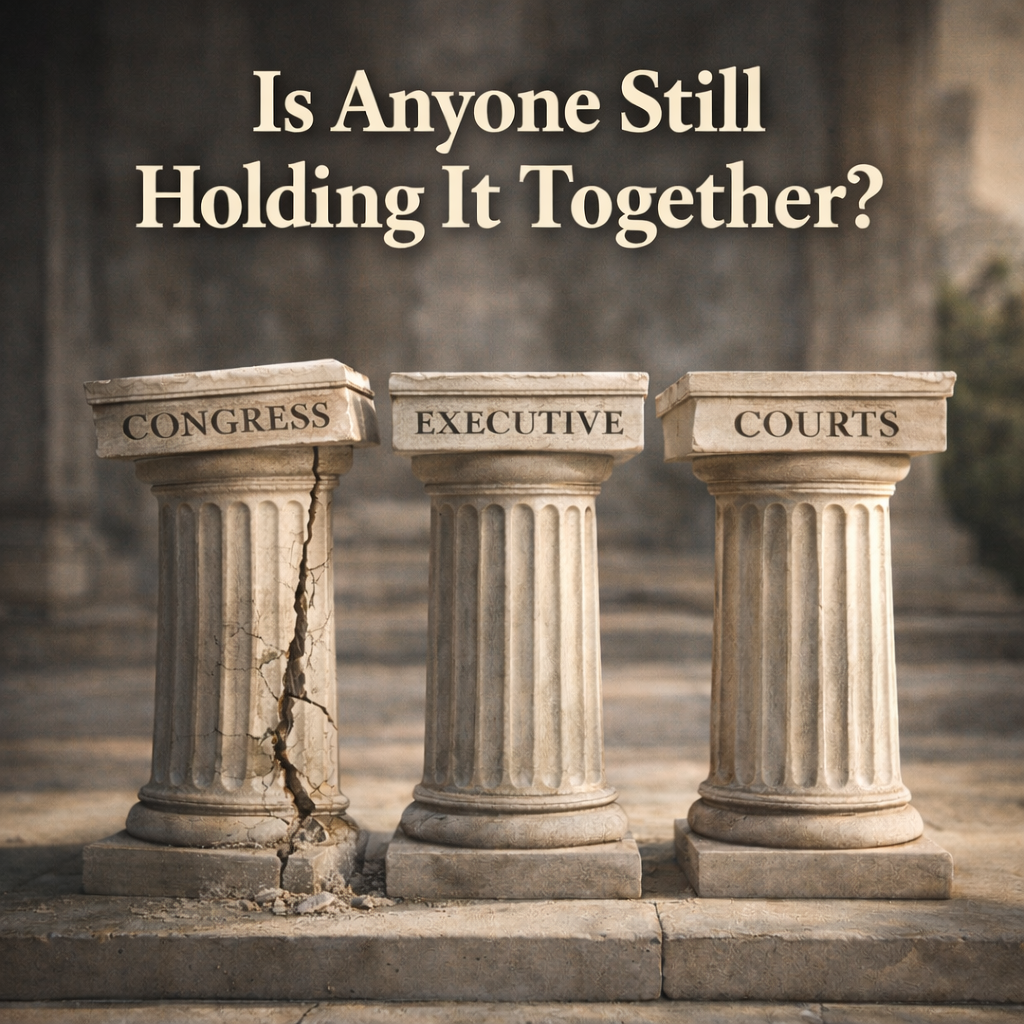
Our system divides authority among Congress, the presidency, and the courts. The idea is straightforward: no single branch should be able to act without constraint from the others. When that balance works, it can feel slow and frustrating. But it also provides stability.
When people tell pollsters that the balance isn’t working, they’re expressing concern about that stability.
Other surveys help explain the mood. Recent research from universities and independent polling groups shows that confidence in elections has declined compared to previous cycles. In one recent study, the share of Americans who said they were confident ballots would be counted accurately dropped significantly from levels recorded after the 2024 election.
That decline spans party lines. It doesn’t belong neatly to one political camp.
Taken together, these numbers don’t prove collapse. They don’t predict the future. What they do show is thinning confidence.
Most Americans aren’t policy experts. They’re not parsing legal doctrines about executive authority or judicial review. They’re reacting to a sense that disputes between branches feel more constant and more unsettled than before. Court rulings are followed by new legal strategies. Executive actions prompt immediate lawsuits. Congress often appears stalled while major decisions shift elsewhere.
That pattern creates an impression — fair or not — that the traditional push-and-pull between branches is strained.
It’s important to be clear about what the polling does and does not say. The survey does not conclude that checks and balances have formally failed. It does not measure constitutional compliance in a legal sense. It measures public perception.
But perception matters in a democracy.
Confidence is part of how the system sustains itself. Citizens are more likely to accept outcomes — even outcomes they dislike — when they believe the process is legitimate and the institutions are functioning as designed.
When confidence drops, uncertainty grows.
You can hear that uncertainty in everyday conversations. People question whether rulings will hold. They question whether Congress will assert itself. They question whether rules feel consistent across administrations.
That questioning doesn’t automatically signal breakdown. It does signal strain.
The American system has always involved tension. Disagreement between branches isn’t new. Legal challenges aren’t new. Fierce elections aren’t new.
What appears to be changing is how many Americans doubt that the friction between branches is producing stability rather than instability.
Two-thirds saying the system isn’t working well is not a small grievance. It reflects broad skepticism about performance — not necessarily about principle, but about practice.
Democracy depends not only on written law but also on shared belief that the law is applied within a framework people trust.
Right now, the polling suggests that trust is under pressure.
That doesn’t answer what comes next. It doesn’t assign blame. It simply records a moment in which a significant majority of Americans feel that the balance of power is not operating smoothly.
That sentiment alone is worth paying attention to.
Not as panic. Not as prophecy.
But as a measure of confidence — and confidence is something any durable system depends on.