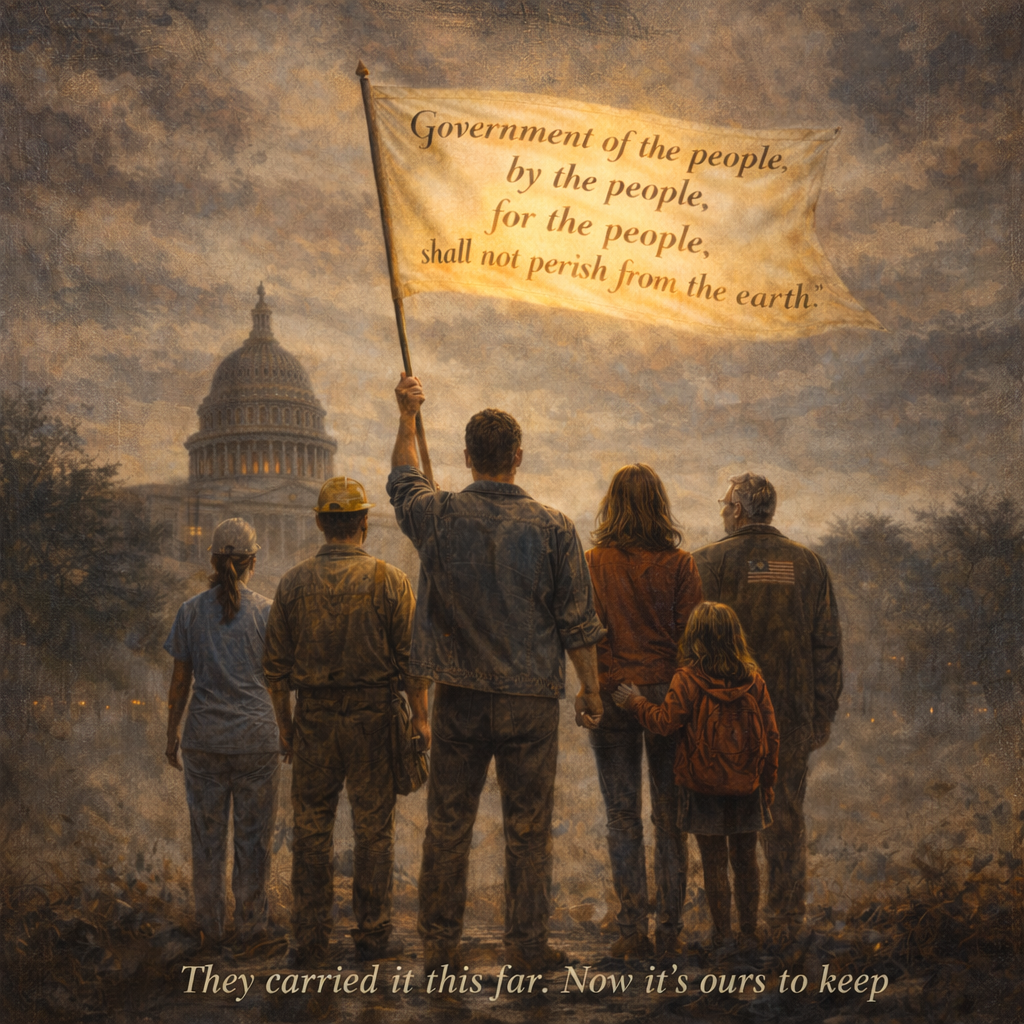
In 1863, standing among fresh graves at Gettysburg, Abraham Lincoln spoke words that still cut through time. In the Gettysburg Address, he said:
“…that government of the people, by the people, for the people, shall not perish from the earth.”
He didn’t say it might weaken.
He didn’t say it might struggle.
He said it could perish.
He was speaking in the middle of a civil war. The country was split. Families torn apart. Fields soaked in blood. And even then, Lincoln believed the deeper question was whether free people could sustain self-government.
That question is still alive.
There are no battlefields in Pennsylvania today. But something feels strained. Fragile.
Look at how Washington operates now.
Presidents increasingly govern by executive order when Congress stalls. Emergency powers are invoked again and again — public health, border, climate, national security. Federal agencies issue sweeping regulations that shape energy prices, healthcare access, student debt, and the survival of small businesses.
Congress passes thousand-page bills few lawmakers have time to read. Budget deadlines come and go. The hard work of governing is postponed, packaged, or handed off.
And when the dust settles, nine unelected justices are often left to decide the most consequential questions in American life.
You won’t see it coming in one obvious flash. There’s no siren, no breaking-news alert that says the balance just tipped.
That’s what makes it serious.
It rarely breaks in one dramatic moment. It thins out, layer by layer, until what’s left barely resembles what we started with.
Power consolidates a little more. Accountability drifts a little further. Responsibility shifts away from the slow, messy process Lincoln believed in — debate, compromise, persuasion — and toward centralized decisions justified by urgency.
Emergencies demand action. That’s true.
But emergencies were never meant to become the default setting of a free republic.
Lincoln understood emergency power. He used it. But he used it to preserve a system where the people ultimately governed — not one where they were managed from a distance.
That is the tension we live in now.
Do we still expect Congress to govern?
Do we still demand that laws be written openly and debated fully?
Do we still believe ordinary citizens should sit at the center of political power?
Or have we grown comfortable letting institutions handle it — while we argue online, shake our heads at the news, and assume someone else will guard the gates?
Democracy does not die only through violence. It fades through indifference. Through exhaustion. Through the quiet belief that participation doesn’t matter.
Lincoln stood before rows of graves and refused to accept that self-government would fail. He believed the American experiment was worth sacrifice, worth vigilance, worth responsibility.
The survival of a republic was never automatic. It required citizens willing to carry it.
That hasn’t changed.
Lincoln believed government “of the people” could endure even after unimaginable division. That belief wasn’t naïve. It was a charge handed to ordinary citizens — farmers, laborers, shopkeepers, parents — people who didn’t hold office but carried the country on their backs. He understood something we sometimes forget: self-government survives only when the people refuse to surrender it to convenience, fear, or fatigue.
It has not perished. Not yet. But freedom is not self-sustaining. It does not run on autopilot. It requires attention. It requires courage. It requires citizens who care enough to notice when the balance shifts — and steady enough to demand it be restored. The promise Lincoln spoke over those graves is still alive. The only question that remains is whether we love it enough to keep it that way.