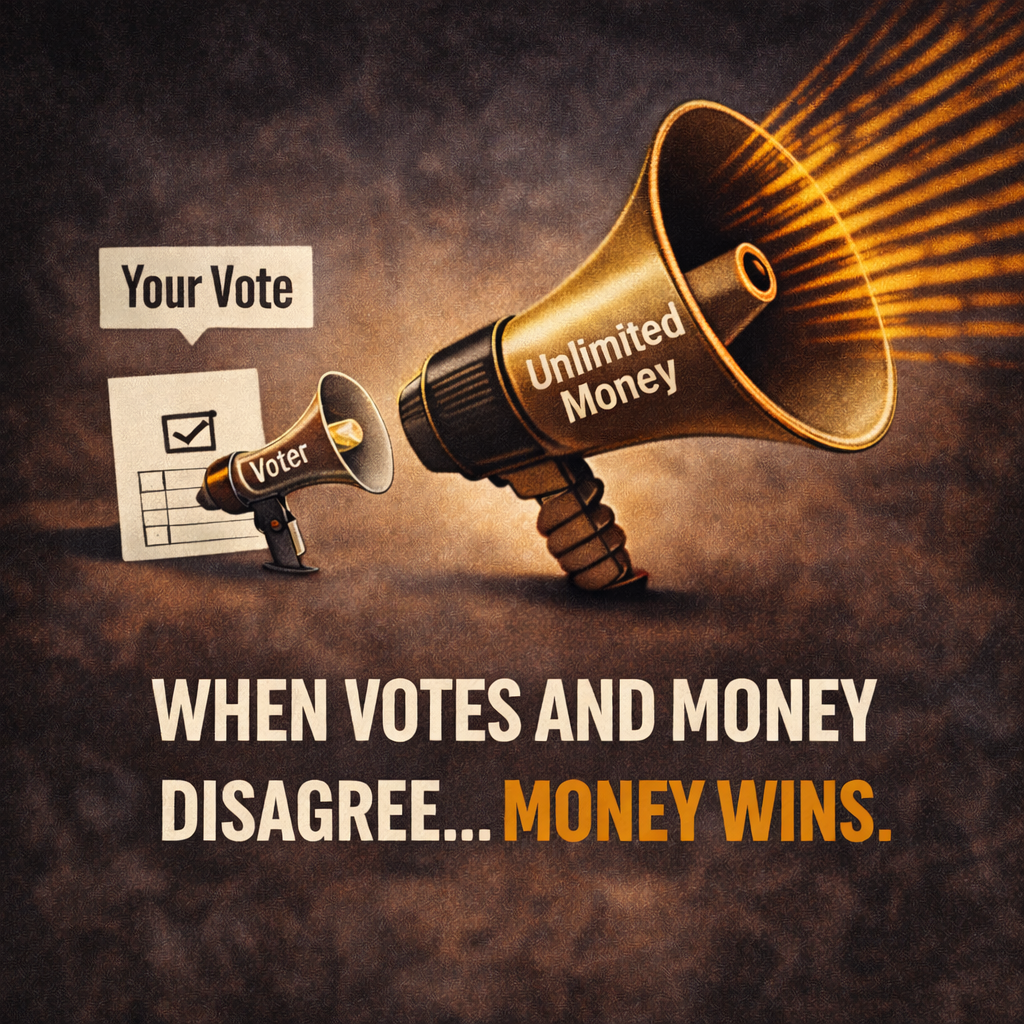
If democracy had a sound, most of us imagine it would be loud.
Crowds. Debates. Applause. Protest signs. Election night maps glowing red and blue.
But the sound that defines modern American politics might actually be quieter than that.
It’s the soft click of a donation processed online.
The closed-door meeting between a lawmaker and a lobbyist.
The fundraising dinner where access is priced per plate.
That’s the machinery most citizens never see — but it’s where policy often takes shape.
We’re taught that if enough Americans agree on something, government eventually responds. That’s the promise. That’s the civic myth that keeps people voting, arguing, hoping.
But when you look at the numbers, that promise starts to thin.
Political scientists Martin Gilens and Benjamin Page analyzed nearly 2,000 policy decisions over two decades. They compared what average Americans wanted with what economic elites and organized business groups preferred.
Then they asked a simple question: whose preferences actually shaped the outcome?
Their conclusion was unsettling. When ordinary citizens and wealthy interests disagreed, policy outcomes overwhelmingly tracked the preferences of the wealthy. The views of average Americans, on their own, had little independent statistical impact.
That doesn’t mean elections are fake. It doesn’t mean public opinion never matters. It means influence isn’t evenly distributed.
And then came Citizens United v. FEC.
In 2010, the Supreme Court ruled that corporations and unions could spend unlimited money on independent political expenditures, treating that spending as protected speech under the First Amendment. Corporations weren’t declared human in a poetic sense — but in the political arena, their financial voice was given expansive constitutional protection.
In practical terms, this meant entities with massive resources could amplify their political preferences at a scale ordinary citizens simply cannot match.
After Citizens United, outside spending in federal elections surged into the billions. Super PACs multiplied. Dark money organizations expanded. Advertising saturation became normal.
Most Americans did not gain a louder voice in that process. But corporations and wealthy donors did.
Money buys repetition. It buys narrative control. It buys the ability to define which issues dominate headlines and which quietly fade. It buys access — the kind that happens long before legislation reaches the floor for a vote.
Meanwhile, the average citizen shows up intermittently. A ballot every few years. Maybe a call to a congressional office. Maybe a town hall question — if one is held.
One side operates constantly. The other participates occasionally.
That imbalance doesn’t look like oppression. It looks procedural. Orderly. Legal.
But it changes the emotional relationship between citizens and their government.
When large majorities support lowering drug prices, protecting Social Security, reducing corporate tax loopholes, or limiting money in politics — and those efforts stall or emerge diluted — people begin to notice a pattern.
The system responds.
Just not evenly.
Gilens and Page didn’t declare the United States an oligarchy in name. They showed that when economic elites have clear, unified preferences, policy outcomes tend to follow them. When average citizens lack organized financial power behind their views, their influence fades.
That realization doesn’t explode.
It settles.
It becomes the reason turnout drops. The reason conversations turn cynical. The reason people say, “They’re all the same,” even when they aren’t.
Democracy rarely collapses in a dramatic moment. It drifts.
And in that drift, the loudest voice isn’t always the one cast on a ballot — it’s the one backed by a check.