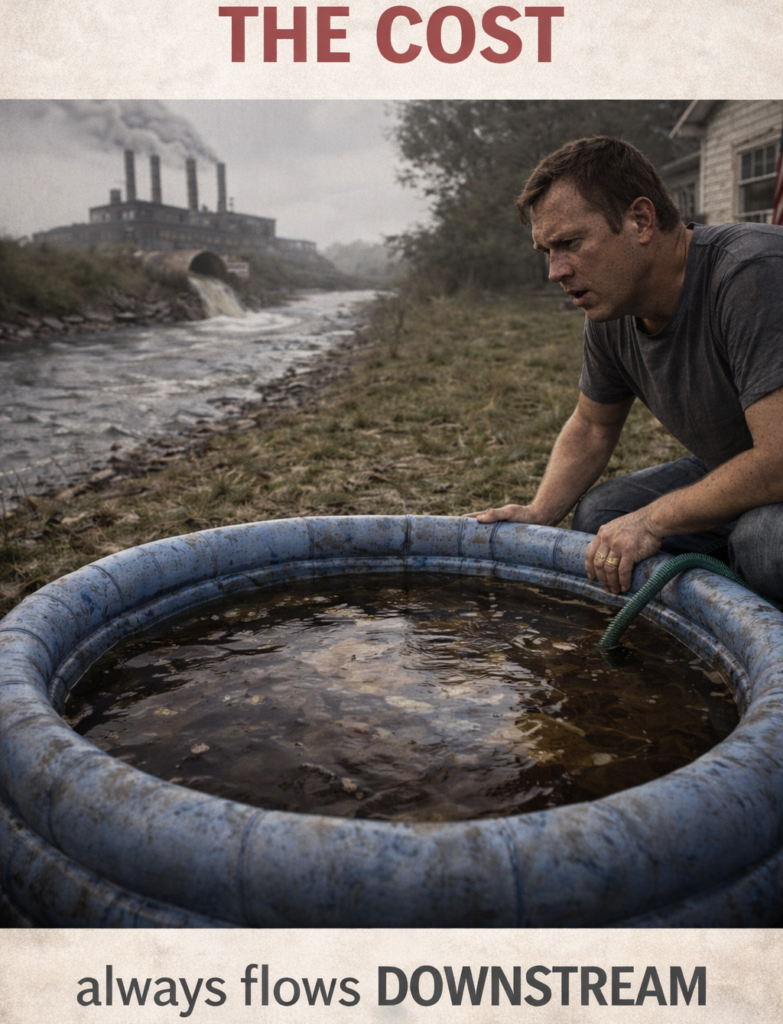
There was a time in this country when a river caught fire — and people shrugged.
Not because they didn’t care.
But because they had been told that this was the price of progress.
In 1969, the Cuyahoga River Fire burned in Ohio. Flames rose from water that had been turned into a dumping ground for industrial waste. Oil slicks floated where children once fished. Smoke climbed into the sky like a warning we could no longer ignore.
An American river was burning.
That didn’t happen overnight. It happened one decision at a time. One shortcut at a time. One calculation that said it was cheaper to dump than to dispose responsibly.
And it wasn’t just one river.
In 1948, in the steel town of Donora, Pennsylvania, a thick cloud settled over the valley. The Donora Smog trapped emissions from nearby mills. The air turned heavy and metallic. People coughed in their kitchens. They wheezed in their beds. Twenty Americans died. Thousands became sick.
Factories kept running.
And then there was Love Canal disaster — a quiet neighborhood in New York where families bought modest homes and planted gardens, never knowing that toxic chemicals were buried beneath their feet. Children got sick. Birth defects rose. The American dream — a house, a yard, stability — dissolved into fear and evacuation notices.
These weren’t accidents of nature.
They were the consequences of a system that put profits ahead of people.
Before the Environmental Protection Agency existed, there was no strong national guardrail. No consistent enforcement. No real consequences for companies that treated air and water like disposable assets.
And here is the hard truth: when there are no consequences, someone always pays.
It just isn’t the corporation.
It’s the family with contaminated well water.
It’s the worker who can’t breathe after decades on the job.
It’s the homeowner whose property becomes worthless overnight.
The response to those disasters wasn’t radical. It was patriotic. Congress passed the Clean Air Act and the Clean Water Act with broad support. Republicans and Democrats agreed on something simple: Americans deserve protection from preventable harm.
Freedom was never meant to mean the freedom to poison your neighbor.
Freedom was meant to mean security — the kind that lets a parent pour a glass of tap water without hesitation. The kind that lets a fisherman trust the river. The kind that protects property not just from theft, but from contamination.
Strong enforcement did not destroy American industry. It made it fairer. It ensured that honest businesses weren’t undercut by bad actors cutting corners to boost quarterly profits.
But when enforcement weakens — when inspections decline and penalties shrink — the balance shifts again. Quietly. Gradually. Almost invisibly.
And once again, the risks move downstream.
They move into hospital bills.
Into asthma inhalers.
Into soil that won’t grow crops the way it used to.
Into communities that don’t have the political power to fight back.
This is not a fight between business and government. It is a question of responsibility. Who carries the burden when things go wrong?
History has already answered that question.
When profits come first, the public absorbs the cost.
When protection comes first, prosperity can grow without leaving scars.
The image of a burning river should never fade from our memory. It is a reminder of what happens when oversight disappears and accountability is optional.
A strong nation does not measure success only in stock prices or production output. It measures strength in the health of its people, the safety of its water, and the trust citizens place in the ground beneath their homes.
The lesson was written in smoke over the Cuyahoga. It was written in the lungs of Donora. It was written in the soil of Love Canal.
Economic growth means nothing if it poisons the people who made it possible.
A free country protects its citizens first.
Not after the damage is done.