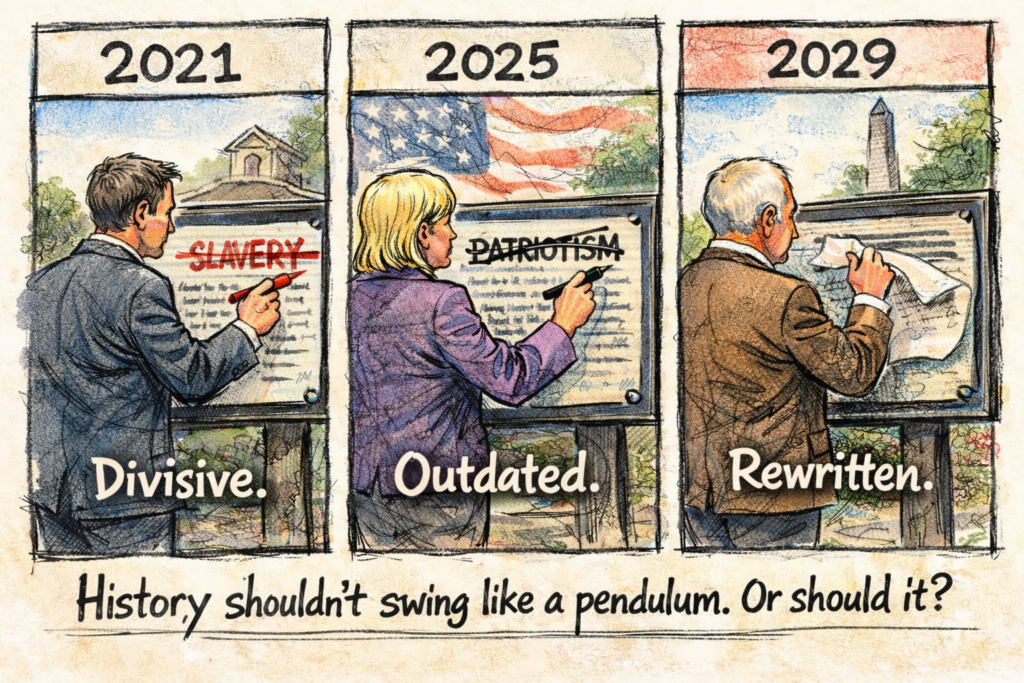
There’s something steadying about walking through a national park and reading the plaques.
You’re not just looking at old buildings or quiet fields. You’re standing in a place where something happened — something that shaped the country. For many families, those signs and exhibits are where kids first learn about slavery and the Civil War, about civil rights marches, about westward expansion, about sacrifice and failure and second chances.
Those markers don’t just explain events. They help explain us.
That’s why the recent lawsuit over changes to historical and scientific displays in national parks has stirred strong reactions.
A coalition of historians and advocacy groups is challenging policy shifts made under the administration of Donald Trump and the Department of the Interior. They argue that certain exhibits were reviewed, revised, or removed in ways that cross the line into government censorship. These parks are overseen by the National Park Service — an institution many Americans see as a caretaker of shared memory, not a political tool.
The disagreement boils down to a difficult question:
Who gets to decide what story the country tells about itself?
Critics of the changes say the federal government should not be in the business of softening or sidelining parts of history — whether that’s slavery, segregation, Indigenous displacement, or climate science. When officials direct what can and cannot be displayed, they argue, it risks turning public history into a reflection of current political preferences.
And that makes people uneasy. Not because Americans can’t handle debate, but because they worry about the precedent. If one administration can adjust exhibits to reflect its priorities, what stops the next administration from doing the same — in the opposite direction? Does history become something steady and reliable, or something that shifts every four years?
For a country that values free expression and limited government, that’s not a small concern.
At the same time, supporters of the policy changes see the issue differently. They point out that federal agencies operate under executive leadership. Elections have consequences. If voters choose a president who believes public institutions have leaned too heavily into certain narratives, isn’t it within that president’s authority to set new direction?
Some Americans also feel that museums and public institutions have emphasized the nation’s failings without giving equal weight to progress and unity. In their view, revisiting exhibits isn’t about erasing the past — it’s about restoring balance and making sure the country isn’t defined only by its worst chapters.
That perspective resonates with people who feel dismissed by cultural gatekeepers or who believe national parks should foster common ground rather than deepen division.
This is where the conversation becomes less about one president and more about the long-term health of democracy.
Freedom of speech is often discussed in terms of private citizens speaking their minds. But it also touches on something broader: who controls the flow of ideas in publicly funded spaces. When the federal government shapes the narrative of American history, it’s reasonable for citizens to ask questions.
Not out of panic. Not out of partisanship. Out of caution.
History shapes how a nation sees itself. And how a nation sees itself influences how it governs.
If Americans come to believe that the version of history presented in public institutions depends entirely on who won the last election, trust erodes. On the other hand, if elected leaders have no ability to influence federal agencies at all, voters may feel their voice carries little weight.
There is tension there. Real tension.
But one thing should remain clear: the American story belongs to the American people. It doesn’t belong to one administration, one ideology, or one moment in time.
We can handle the full record — the achievements and the failures. We can argue about emphasis and interpretation. That debate, carried out openly, is part of what keeps a free society alive.
The greater risk isn’t disagreement. It’s indifference. It’s when citizens stop paying attention to who controls public institutions because they assume the outcome is predetermined.
So perhaps the deeper question isn’t whether this administration went too far, or whether critics are overreacting.
Perhaps the real question is this:
Should the telling of America’s history be steady across administrations — or should it change with each election?
That isn’t a red-state or blue-state issue.
It’s a question about freedom. And it deserves an honest conversation.