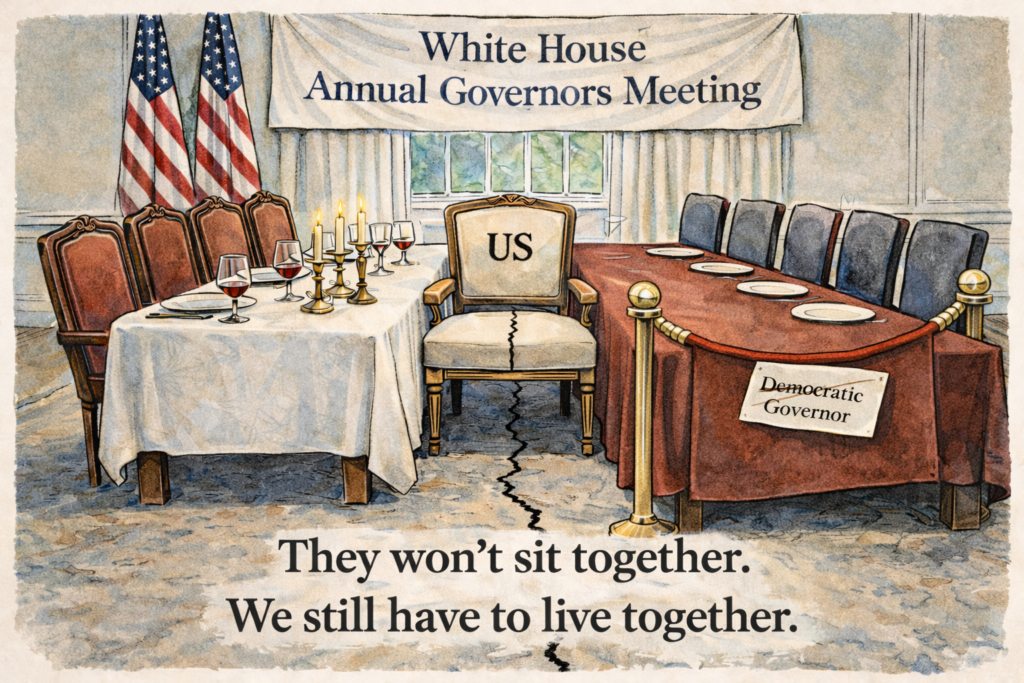
For decades, there was one moment each year when the temperature in Washington cooled—at least a little.
Republican and Democratic governors would gather under the banner of the National Governors Association. They would sit at the same tables. Compare notes on disasters, budgets, jobs, roads, public safety. Then they would walk into the White House together to meet the president—no matter which party he belonged to.
It wasn’t flashy. It didn’t trend on social media. But it symbolized something steady: in America, we compete hard in elections, and then we govern together.
This year, that tradition cracked.
Parts of the White House gathering were limited to Republican governors. Democratic governors—including Wes Moore, the NGA’s vice chair—were excluded from the traditional business session and dinner. In response, the NGA pulled the White House event from its official agenda. Several Democratic governors boycotted.
On paper, it’s a guest list dispute.
In reality, it’s something heavier.
Because that meeting has never been about party politics. It’s about disaster relief after tornadoes. It’s about coordinating National Guard deployments. It’s about infrastructure money, opioid response, border security, wildfire management, and pandemic preparedness. It’s about making sure when something goes wrong in Ohio, Texas, California, or Iowa, the federal government and the states know how to work together.
When that space becomes partisan, it sends a signal: loyalty to a political team may matter more than shared responsibility to the country.
President Donald Trump has long relied on division as a political strategy. Drawing sharp lines energizes supporters. It simplifies complicated issues into us-versus-them battles. In campaigns, that can be effective.
But governing is different.
Division as a governing tactic carries a cost. It makes it harder for Americans—red and blue alike—to maintain the very things they care most about: freedom and security.
Freedom depends on institutions that function fairly. When leaders appear to reward allies and sideline opponents, even symbolically, trust erodes. And trust is the oxygen of democracy. Without it, every action looks suspicious. Every decision feels political.
Security depends on coordination. Hurricanes don’t check voter registration. Cartels don’t ask whether a governor is Republican or Democrat. Cyberattacks don’t care who won the last election. The strength of the American system has always been its ability to unite quickly across levels of government when it matters.
If governors from half the country are effectively shut out of regular dialogue, even for a moment, that cooperation weakens.
Most Americans—especially those in small towns and working communities—don’t want endless partisan drama. They want potholes fixed. Borders managed. Crime addressed. Storm damage repaired. Jobs protected. They assume their leaders, even if they argue, will eventually sit down and work it out.
That assumption is part of what makes America stable.
When even an annual bipartisan governors’ meeting turns into a partisan standoff, it chips away at that stability. It tells citizens that common ground is shrinking. That symbolic unity no longer matters.
And symbols matter more than we think.
Democracy is not just laws and elections. It’s norms. It’s the habit of inclusion. It’s the discipline to treat political opponents as legitimate participants in governing. Once those habits fade, restoring them is difficult.
Division may win headlines. It may rally a base. But over time, it narrows the space where freedom and security are protected together. It pushes Americans into camps rather than into shared problem-solving.
If leaders cannot share a table once a year, how will they share responsibility when the next crisis hits?
America’s strength has never come from uniformity. It has come from the messy, frustrating, sometimes loud practice of governing a diverse country together.
When that practice weakens—even symbolically—it’s not just tradition that’s lost.
It’s a warning.