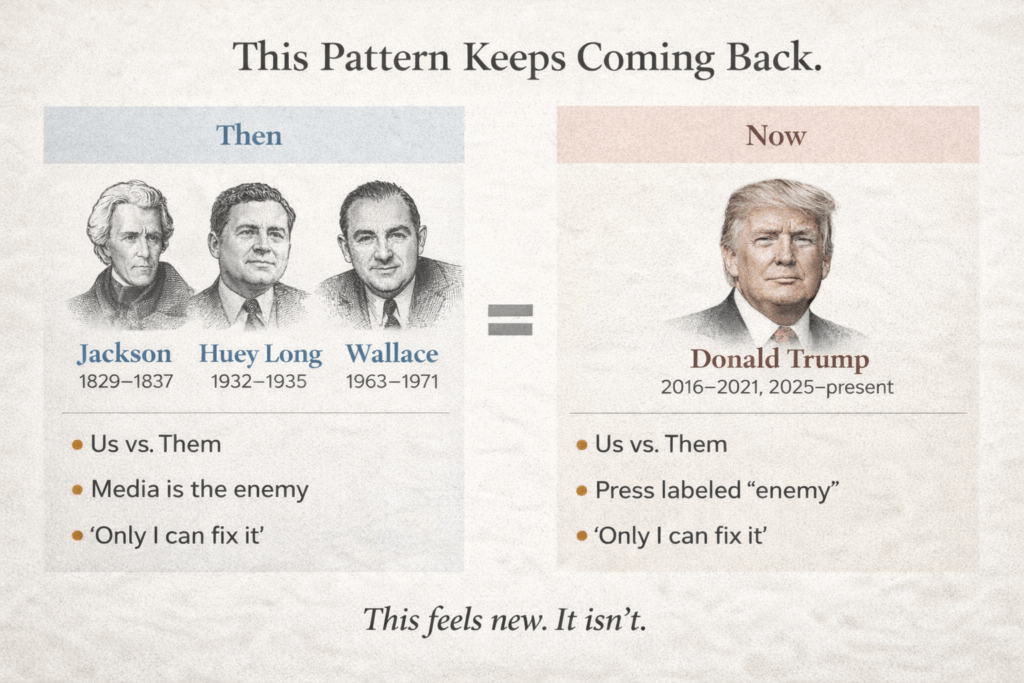
People talk about Donald Trump as if he fell out of the sky—an accident, a glitch, a singular threat that appeared out of nowhere. That story is comforting. If Trump is unique, then removing him fixes the problem.
But it isn’t true.
Trump didn’t invent this kind of politics. He didn’t even refine it. He stepped into a role that has existed, in different forms, throughout American history: the leader who turns grievance into identity, conflict into loyalty, and attention into power.
What makes Trump feel unprecedented isn’t what he represents. It’s how clearly he reveals a pattern the country has never fully reckoned with.
The ground always cracks first
Before figures like Trump rise, something else happens first: trust breaks.
People stop believing institutions speak for them. They stop believing rules are neutral. They stop believing patience will be rewarded. The specifics change—land, labor, race, globalization, culture—but the feeling stays the same: the country is moving on without us.
By the time Trump announced his candidacy in 2015, that feeling was already widespread. Trust in Congress was near historic lows. Confidence in media and government had been eroding for decades. Wages had stagnated while productivity climbed. The gap between promise and reality felt personal.
Trump didn’t convince people the system was rigged. He said out loud what many already believed—and, just as importantly, he said it without apology.
Recognition mattered more than policy
One of the biggest mistakes people make when trying to understand Trump’s appeal is assuming it was primarily ideological. For many supporters, it wasn’t.
It was emotional.
Trump spoke in blunt, repetitive, angry language that sounded closer to how people talk when they’re frustrated and fed up. He insulted institutions his supporters already resented. He broke norms they felt had never protected them anyway.
To critics, this looked like chaos. To supporters, it looked like honesty.
Once politics becomes about recognition—about who sees you and who doesn’t—facts stop functioning the way we expect them to. Criticism doesn’t land as information. It lands as judgment. And judgment, especially from institutions already seen as hostile, only hardens loyalty.
That’s why scandals didn’t weaken Trump. They clarified the sides.
Conflict was the point, not the cost
Trump understood something that many of his opponents didn’t want to accept: modern politics isn’t mainly about persuasion. It’s about alignment.
He didn’t need to convince people he was flawless. He needed to convince them he was their fighter.
Every investigation, every condemnation, every breathless headline reinforced the same story—that powerful forces were trying to take him down. For supporters who already distrusted those forces, the message was simple: if they hate him this much, he must be doing something right.
This isn’t a failure of intelligence or morality. It’s what happens when trust collapses. Once the referee is rejected, the game changes.
This isn’t new—and it isn’t rare
America has seen versions of this before. Andrew Jackson defied institutions in the name of “the people.” Huey Long built devotion by validating resentment and concentrating power. Joseph McCarthy thrived by convincing followers that experts and institutions were compromised. George Wallace mobilized voters by turning cultural displacement into identity.
Different eras. Different issues. Same emotional math.
Trump didn’t copy these figures. He didn’t need to. The conditions that elevate this kind of leader reappear whenever large numbers of people feel ignored, disrespected, or shut out of decision-making that shapes their lives.
The mistake Americans keep making is focusing on personality instead of pattern. We argue endlessly about whether a particular leader is uniquely dishonest, cruel, or dangerous—and avoid asking why this role keeps reappearing at all.
What it actually takes to stand up to someone like Trump
History also makes something else clear: figures like Trump don’t draw their power from being right. They draw it from conflict—from the sense that someone is finally fighting on behalf of people who feel dismissed.
That’s why outrage so often backfires. Fighting harder inside the frame Trump set—us versus them, real people versus enemies—only strengthens the dynamic that sustains him.
Standing up to someone like this means refusing that frame altogether.
It means defending democratic institutions without pretending they’re flawless, and acknowledging—honestly—why so many people stopped trusting them in the first place. It means offering dignity instead of condescension, and solutions instead of constant emergency. And it means resisting the temptation to turn every moment into spectacle, because spectacle is the oxygen this kind of politics breathes.
There is no single dramatic confrontation that breaks the spell. What weakens it is slower and less satisfying: rebuilding trust, reducing the economic and cultural pressures that turn grievance into identity, and creating systems that actually deliver fairness instead of merely promising it.
Trump didn’t invent this role. Which means it can be dismantled.
Just not by yelling louder than he does.