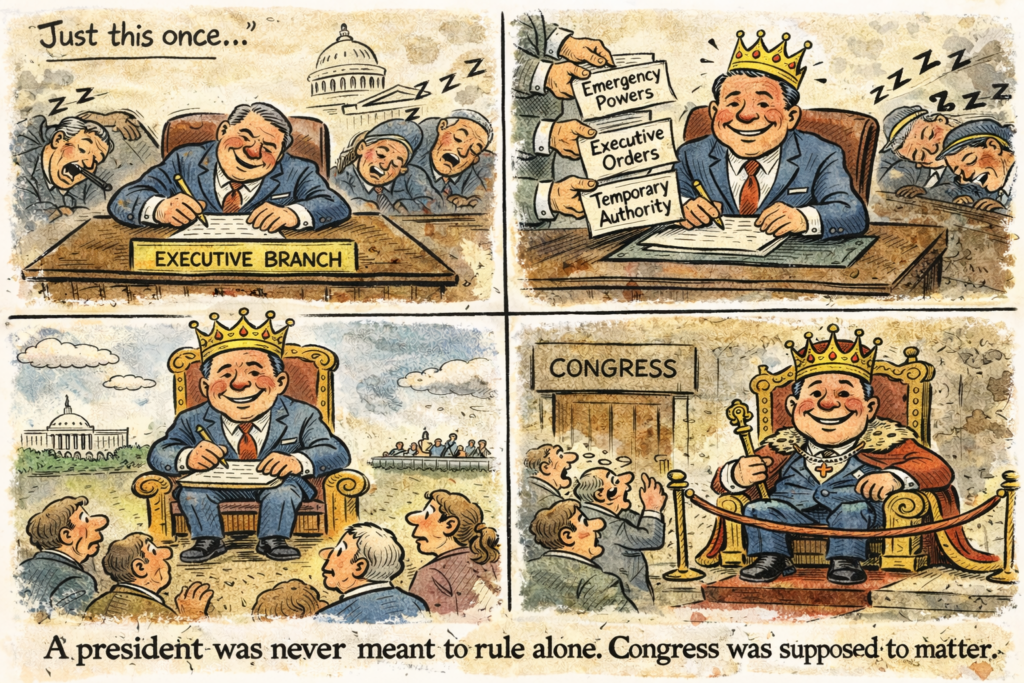
Most of us grew up believing something simple: the Constitution protects our rights, and the three parts of government — Congress, the courts, and the presidency — keep each other in check. One branch doesn’t get too powerful. That’s how freedom survives.
But today, that balance is breaking.
Freedom isn’t disappearing with soldiers in the streets or martial law on every corner. It’s slipping away quietly, through a slow expansion of executive power that most Americans barely notice in day-to-day life. Far too often, the executive branch is acting without clear approval from Congress — and that’s dangerous for every American, no matter your party or point of view.
The U.S. Constitution gives Congress the power to make laws, control spending, regulate commerce, and represent the people. That’s Article I, Section 1 — and those powers were meant to be the backbone of our system. But when presidents rely too heavily on executive orders, emergency powers, or unilateral decisions, those core duties get sidelined. In the first 100 days of the current administration, critics and scholars have raised alarms that executive actions are stretching well beyond what most Americans would consider within normal checks and balances.
This isn’t a new debate. It goes back to the very founding of the nation, when leaders argued over how much authority the president should have compared to Congress. Over time, presidents have used wartime powers, national emergencies, and executive actions to get around a gridlocked Congress — and that trend has only grown.
Think about what that means in everyday terms.
If the president can act without Congress, then the voice of the people — the ones who elect senators and representatives — gets weaker. That’s not democracy. That’s centralized power.
You might hear people say, “Well, a president needs flexibility.” And that’s true — to a point. The Constitution gives presidents certain authorities. But it also gives Congress the responsibility to write laws, set budgets, approve treaties, and declare war. When presidents bypass those duties, they aren’t showing leadership — they’re concentrating power.
A recent report from a major watchdog group explained that this overreach isn’t just abstract. It affects real policy decisions: the use of federal funds without congressional approval, expanded emergency powers, and unilateral actions that shift major national priorities without debate.
And that’s exactly why our system was designed with checks and balances in the first place. Congress was meant to be messy, slow, and deliberative. That’s not a flaw — it’s a safeguard. When laws are debated publicly and passed openly, more voices are heard, more perspectives are considered, and power is spread out. When a single person or office makes big decisions alone, that’s when freedom starts to fade.
Here’s the truth: if Congress doesn’t act, we will lose what made this country strong.
We cannot stand by while fundamental powers of government are quietly shifted away from the people’s branch. We cannot let emergency powers become permanent tools of governance. And we cannot allow the executive branch to operate without clear limits.
This is not about political side taking. This is about defending the core of our constitutional democracy. We have seen the danger of concentrated power before — in other nations, and in moments when citizens fail to speak up in time.
So here’s the call to action that Americans need to hear:
Tell your members of Congress: they must reclaim their constitutional authority.
Tell them to stop deferring to the executive branch.
Tell them to hold hearings, pass laws, and enforce the Constitution they swore to uphold.
Tell them that freedom requires active defense, not quiet surrender.
Our system only works when the people demand it works.
If Congress doesn’t take back its power from the executive branch, we risk a future where freedom is not a living reality, but just a memory. And no generation deserves that.