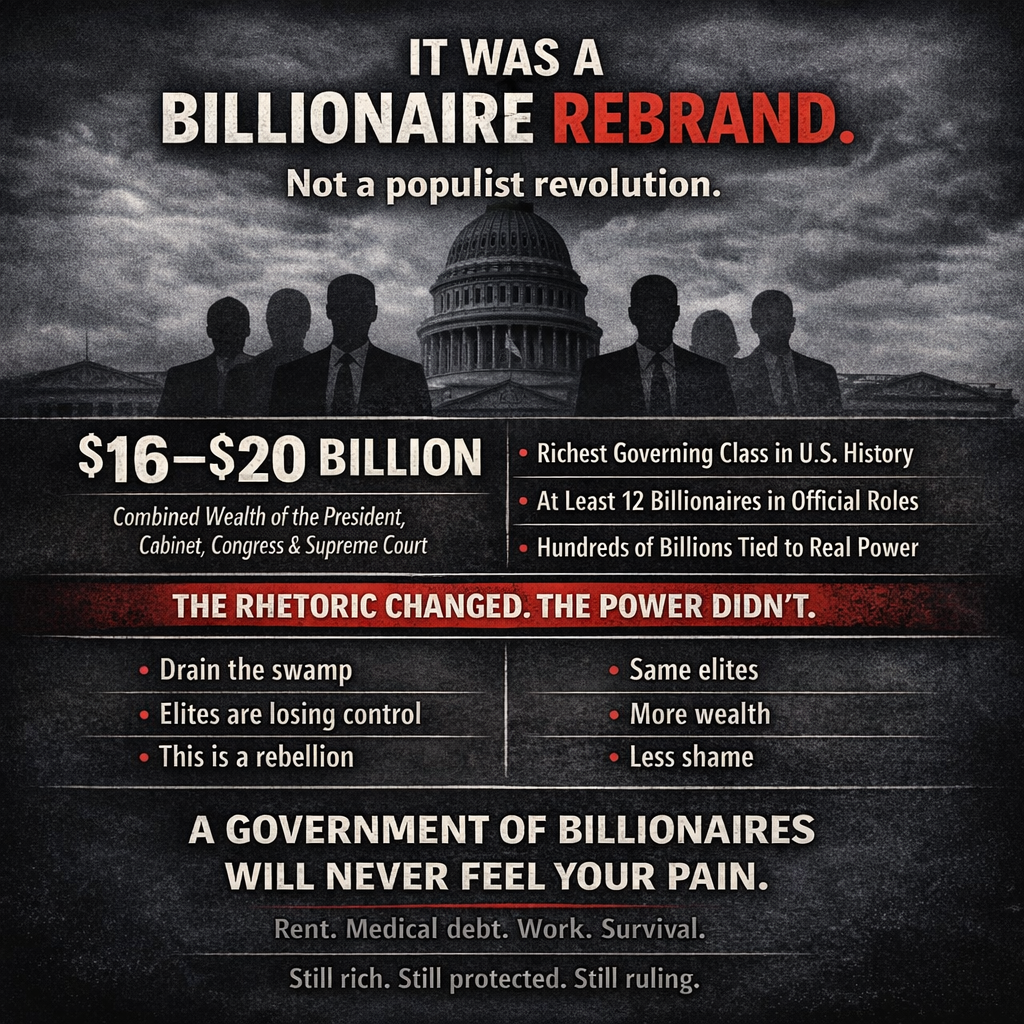
They didn’t just lie to you. They counted on you wanting to believe the lie. They told you this time would be different—that the billionaires were gone, that the insiders were out, that the people finally had the wheel. And while millions of Americans argued, hoped, and voted on that promise, the richest governing class in U.S. history quietly took power. Not behind closed doors. Not by accident. But openly—because they knew most people wouldn’t look at the numbers.
So let’s look at the numbers.
Using conservative, publicly available estimates, the combined net worth of the President, the Cabinet, Congress, and the Supreme Court under Donald Trump’s current term lands between $16 and $20 billion. That figure alone should shatter the myth that this was ever a populist takeover.
Donald Trump himself is worth roughly $6.5 billion. His Cabinet—counted narrowly, excluding informal advisers and political allies—is estimated at $7.5 billion, making it the richest Cabinet in American history. Congress, despite reporting wealth only in broad ranges, collectively sits in the low billions. Even the Supreme Court, supposedly insulated from politics, adds another $64 million.
This is the core of American governance. And it is overwhelmingly wealthy.
But here’s where the deception deepens. That $16–$20 billion figure is the sanitized version. It’s what you get when you only count clean titles and confirmed roles. When you widen the lens to include billionaire appointees, envoys, and officials with real governing power, the wealth tied directly to the administration explodes into the hundreds of billions of dollars.
At least twelve billionaires have held official roles in Trump’s administration, with a combined net worth approaching $400 billion. That isn’t an accident. It’s not a coincidence. It’s a statement about who this government is built for—and who it isn’t.
And yet people were told this was a rebellion.
They were told the elites were losing control.
They were told the swamp was being drained.
Instead, it was rebranded.
What makes this betrayal so effective is the performance. The language of anger. The promise of revenge against a system people already knew was rigged. A billionaire surrounded by other billionaires convinced millions that wealth itself had suddenly become proof of loyalty to working people.
But wealth doesn’t liberate power. It concentrates it.
This isn’t about personalities. It’s about incentives. When people worth billions run the government, your problems are not their problems. Rent is an abstraction. Medical debt is theoretical. Labor protections are obstacles. Regulation is “friction.” Public goods are inefficiencies on a spreadsheet.
And before anyone rushes to say “this isn’t new,” they’re right—and that’s the point. Democrats spent decades staffing government with corporate lawyers, financiers, and revolving-door regulators. That failure created the hunger for something different.
But this wasn’t different.
It was the same elite control, stripped of shame and dressed up as rebellion.
The illusion worked because it told people what they wanted to hear while delivering the same result: a government insulated from the consequences of its own decisions.
So if you feel angry—good. That anger means you’re seeing the gap between the promise and the reality. You were told the rules had changed. They hadn’t.
The rhetoric changed. The tone changed. The villains were rearranged.
But the people in charge?
Still rich. Still protected. Still ruling.
And this time, they didn’t even bother to hide it.