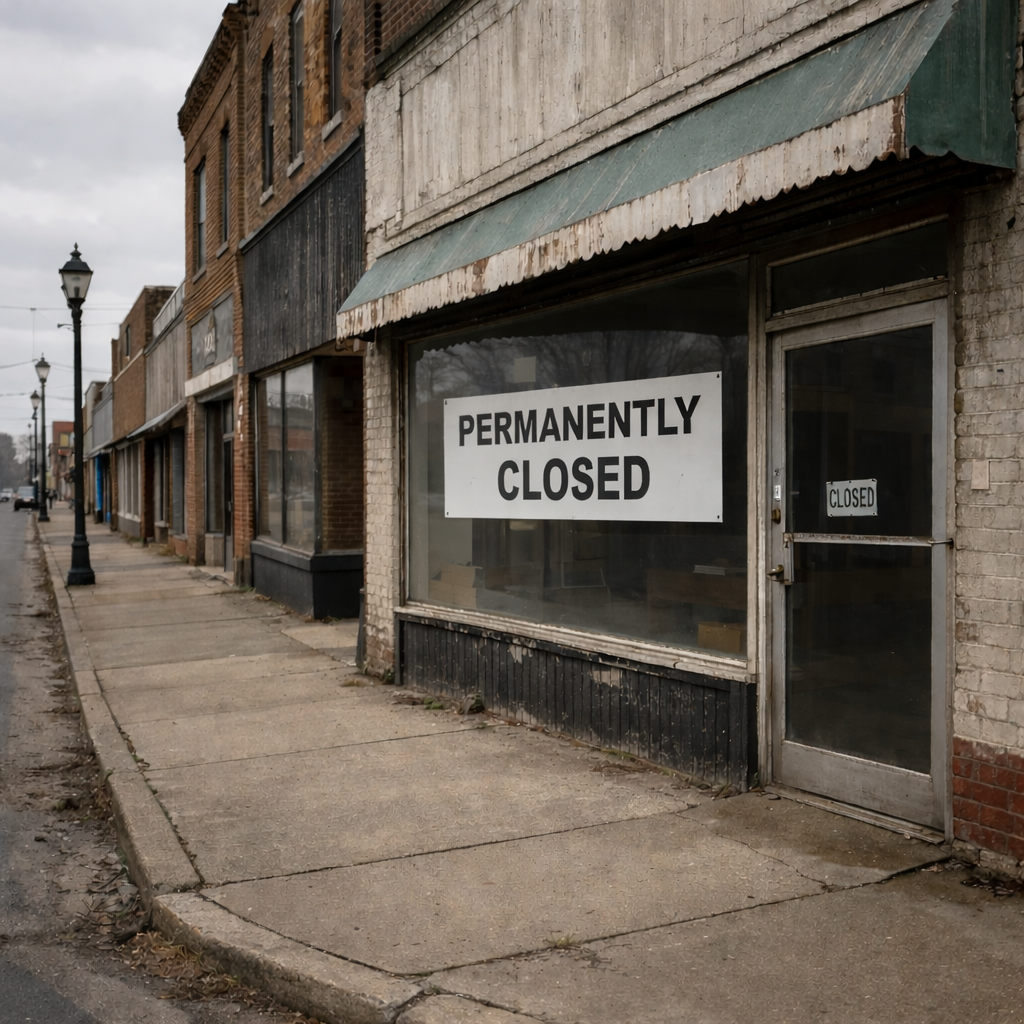
The sign in the window says Permanently Closed.
It doesn’t say why. It never does.
It doesn’t mention the owner who unlocked that door every morning for twenty years. Or the kid who worked there after school. Or the older couple who stopped in just to talk for a few minutes because it was better than sitting alone at home.
It just says the end has arrived—and that nobody is coming back.
We keep being told the economy is strong. We hear it on the news, in speeches, in carefully worded reports filled with charts and percentages. Growth is up. Markets are up. Confidence is up.
But if the economy is doing so well, why does every town seem to have one more dark storefront than it used to?
Why does Main Street feel quieter every year?
This place didn’t close because people stopped working hard. It didn’t close because the town lost its pride. It didn’t close because folks here suddenly forgot how to show up, open up, and grind it out day after day.
It closed because somewhere far away, a decision was made that this place no longer mattered enough.
That’s the part nobody likes to talk about.
When decisions are made by people who don’t live here, shop here, or raise families here, they don’t feel the consequences. They see numbers. They see efficiencies. They see profit margins. They don’t see empty sidewalks on a Tuesday afternoon or a “For Sale” sign that never comes down.
They don’t see the slow unraveling.
For the people who live here, decline doesn’t arrive all at once. It comes quietly. First a store closes. Then another. Then the hours at the diner get shorter. Then the high school graduate leaves and doesn’t come back. Then the downtown lights stop coming on at night.
Nobody announces it. There’s no press conference. No warning. Just a steady shrinking of the life that used to fill these places.
And the hardest part is being told—over and over again—that this is somehow normal. That it’s progress. That it’s just how things work now.
People here know that’s not true.
They remember when a job meant stability, not just survival. When working hard actually got you somewhere. When owning a small business wasn’t a gamble stacked against you from day one.
They remember when success didn’t require moving away.
What hurts most isn’t just the loss of income or convenience. It’s the feeling of being dismissed. Of being told, politely and repeatedly, that your experience doesn’t match the official story.
That if things feel harder, it must be your imagination.
But it’s not.
You don’t imagine empty buildings. You don’t imagine fewer choices. You don’t imagine watching your town fade while being told everything is fine.
This isn’t about nostalgia. It’s about dignity.
Places like this didn’t fail. They were sidelined. Replaced. Moved past by systems that reward size, speed, and scale—while forgetting the people who kept things running long before everything was automated, centralized, and stripped down to a spreadsheet.
The sign says Permanently Closed. But what it really means is that something solid was lost, and nobody bothered to ask the people here what that loss would cost them.
A strong economy should be visible where people live.
Until it is, those headlines won’t mean much on Main Street.