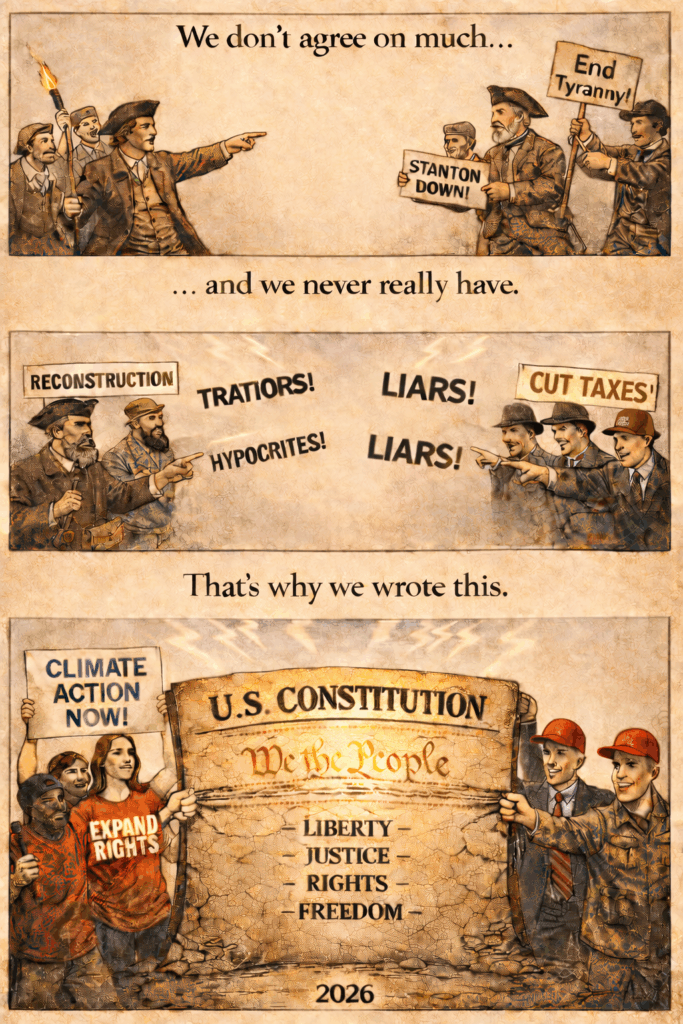
Before America was a nation, it was a gamble — a reckless wager that millions of loud, stubborn people could govern themselves without a king, without fear, and without losing the fragile freedom they had just paid for in blood. In a sealed room in Philadelphia, the heat thick and tempers thin, that gamble became ink — and the ink became the U.S. Constitution.
We often treat it like a museum artifact, but the Constitution was not written for glass cases. It was written for conflict. For chaos. For a future none of the framers could predict — a future that looks more like ours than their own.
At its most basic level, the Constitution does something radical:
It takes power and breaks it into pieces.
The legislative branch writes the laws.
The executive enforces them.
The judiciary interprets them.
Each branch can frustrate, delay, question, and restrain the others. That friction — the gridlock people complain about — is not a malfunction. It’s the point. The framers knew concentrated power is fast and efficient, but fast and efficient governments become tyrants. Slow governments protect liberty.
Then comes arguably the most explosive idea in the entire document: sovereignty doesn’t start at the top — it starts with the people. The government is legitimate only because we consent to it, and we can withdraw that consent through elections, petitions, courts, speech, and even amendment.
And when the ink dried, people demanded more. They demanded a shield strong enough to protect the individual against the machine of the state. That shield became the Bill of Rights.
The First Amendment protects speech, religion, the press, assembly, and petition — not because those freedoms are convenient, but because they are dangerous. They let ordinary people criticize, organize, and challenge power.
The Second protects the right to defend oneself and one’s community.
The Fourth and Fifth guard privacy, due process, and property.
The Sixth and Eighth defend fairness in trials and punishment.
These rights are not gifts from the government. They are limits to the government — lines it cannot cross even when the moment feels urgent, even when the majority is afraid, even when the country is angry.
As the nation grew, the Constitution grew with it. Through amendments we abolished slavery, guaranteed equal protection, extended voting rights to women, ended poll taxes, lowered the voting age, and clarified presidential succession. Every amendment is a reminder that the Constitution is not a tombstone of old ideas; it is a living argument about who “We the People” are allowed to be.
And here’s the part that feels most urgent today: the Constitution doesn’t exist to serve people who agree. It exists to keep disagreement from becoming destruction. It forces battles into courts and legislatures and elections instead of into streets and prisons. It demands that we defend the rights of people we dislike, and preserve freedoms we personally may never use.
That restraint — that willingness to let our opponents speak, vote, and exist — is not natural. It has to be taught. It has to be expected. And it has to be protected.
More than two centuries later, the Constitution remains the only thing powerful enough to shield us not just from the government, but from each other — from the moment when fear or fury convinces one faction to silence the rest. Its survival has never been automatic. It still isn’t.
Whether we lean left, right, or somewhere unclaimed, the Constitution gives us a place to argue without becoming enemies, to change without tearing ourselves apart, and to hope without needing perfection.
It is not just a national document — it is a warning, a promise, and a responsibility. And we cannot afford to forget any of it.