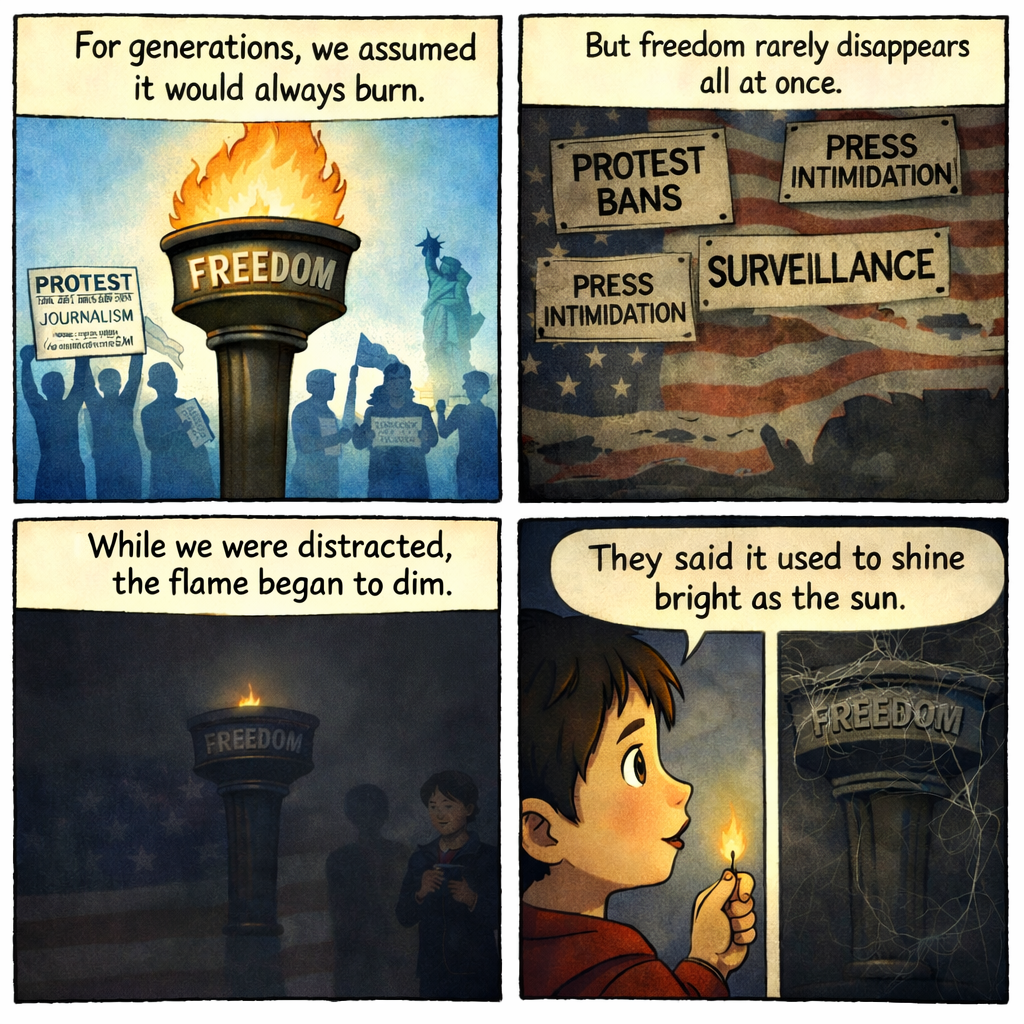
There’s a particular kind of heartbreak in realizing that the freedoms you always assumed were permanent might have been temporary all along. That the rights you believed were your birthright — to speak, to protest, to question, to gather — could fade without sirens or headlines, without any single moment when anyone declared they were gone. Most Americans never imagined they would have to defend the very liberties their grandparents once believed were untouchable. Yet here we are, blinking through the fog of denial as global watchdogs warn that the United States is no longer the beacon it once was, but a country slipping into the same civic shadows we once pitied from afar.
Those warnings are not coming from pundits or rivals. They are coming from organizations like CIVICUS Monitor, a non-partisan alliance that evaluates civic freedoms in nearly every nation on Earth. CIVICUS measures how freely people can assemble, associate, and speak — and whether journalists, activists, and civil-society groups can operate without harassment or fear. Their civic-space scale ranges from Open to Closed, passing through Narrowed, Obstructed, and Repressed. (Source: CIVICUS Monitor rating system — monitor.civicus.org/about/how-it-works/ratings/)
In its latest assessments, the United States — a nation that once helped define modern liberty — was reclassified as “Obstructed.” That sterile word masks a harsh reality: a country where peaceful protests can meet force, journalists face interference or intimidation, civil-society groups encounter bureaucratic or legal obstacles, and ordinary citizens begin to self-censor. (Source: CIVICUS U.S. downgrade — monitor.civicus.org/press_release/2025/united-states-of-america/)
To understand how serious that is, look at the nations that share that label. Other “Obstructed” states include Hungary, Brazil, South Africa, Indonesia, El Salvador, Mongolia, and Morocco — countries whose civic spaces are widely acknowledged to be shrinking. (Source: CIVICUS data portal — monitor.civicus.org/data/) Nearly 40 nations now occupy that tier globally.
But here is the uncomfortable truth: the decline did not begin in January 2025. The downgrade may feel sudden, but the erosion has been unfolding quietly for years.
Freedom House, which tracks political rights and civil liberties worldwide, has been lowering the U.S. score for more than a decade. The country has fallen 11 points in the last 13 years, citing polarization, weakened checks on power, and contested elections. (Source: Freedom House, Freedom in the World — freedomhouse.org)
The academic consortium V-Dem Institute likewise documented multi-year democratic backsliding, warning of “substantial autocratization” in the United States before the current presidency began. (Source: V-Dem Democracy Report — v-dem.net)
Even January 6, 2021 is now treated by democracy researchers not as an anomaly, but as a symptom of institutional vulnerability. Both Freedom House and the Brookings Institution cited it as evidence that democratic norms had already weakened. (Sources: Freedom House “Democracy in the United States: What to Watch in 2025”; Brookings “Understanding Democratic Decline in the United States”)
If anything, the current administration is an accelerant, not the spark. Civic freedom rarely dies in flames; it dies in drafts — in normalization, in self-censorship, in citizens adapting to smaller and smaller spaces for dissent until the space finally closes.
This is not a liberal warning or a conservative one. It is a civic warning. The right to dissent is not a gift from the powerful — it is a guardrail against them. If the United States is truly joining the ranks of countries where protest invites force, journalism invites surveillance, and civil society operates under suspicion, then the danger is not ideological — it is national.
What Can Be Done — and By Whom?
Civic erosion is reversible when confronted early. In practical terms, that means:
protecting press freedom, defending the right to protest (even for opponents), re-strengthening democratic guardrails, reducing structural incentives for polarization, rebuilding civic literacy, and supporting civil-society organizations that keep power accountable.
None require waiting for the “right” party to win. They require citizens who refuse to outsource democracy to institutions that benefit most when it decays.
America’s strength was never measured by tanks or treaties, but by the space it carved for dissent. Do we still believe freedom is worth the inconvenience of defending it?
Because if we do, there is still time. If we don’t, the timeline doesn’t matter. The ending is already written.