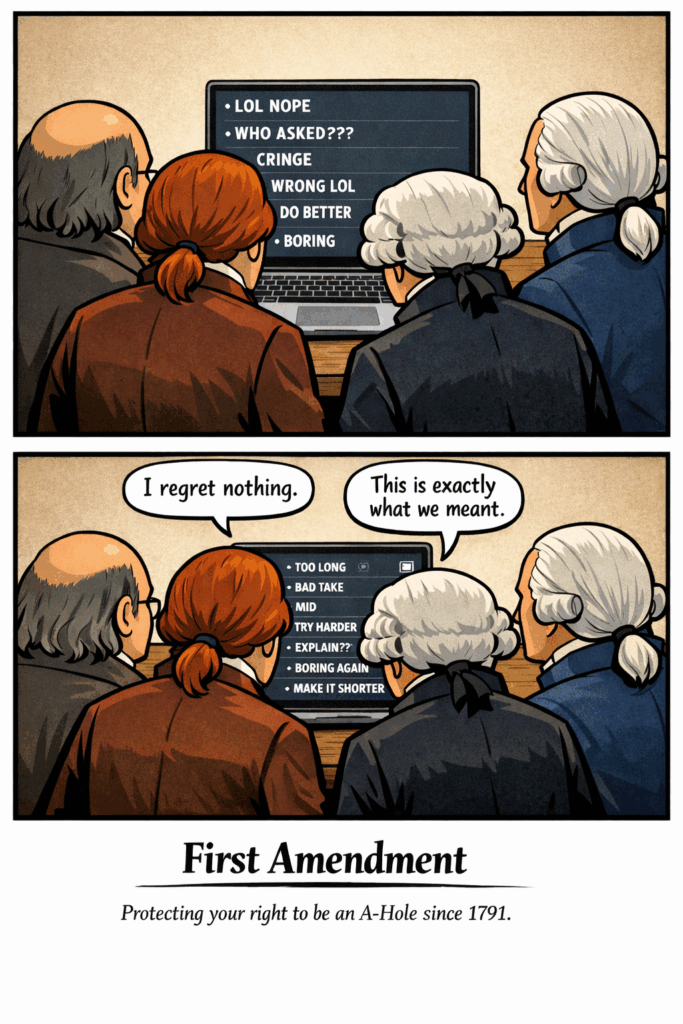
America has always been a symphony of voices. Some trembling. Some thundering. Some cracked with grief, others soaring with hope. From the very beginning, ordinary people have risked their livelihoods, their safety, and sometimes even their lives just to speak a truth burning inside them.
That noise—messy, imperfect, and beautifully human—is not chaos. It is the sound of a free people learning who they are. And without the First Amendment, that sound would fall into silence.
The First Amendment may look simple on paper: speech, press, religion, assembly, petition. But in practice, it is extraordinary. It is the microphone lifted into the air. The candle held at a vigil. The ink that refuses to stop flowing from a journalist’s pen. The whispered prayer that government cannot outlaw. The petition that says, with courage, “You have gone too far.”
It tells the state: you do not own our voices. You do not own our hearts. We do.
And these freedoms belong to everyone, no matter where they stand on the political spectrum.
To the left, they carried civil rights marchers across bridges. They helped women earn the right to vote. They empowered union workers to demand dignity. They gave artists and activists the room to imagine a more just world.
To the right, they defended pulpits and pews. They protected pro-life rallies and gun rights advocacy. They fueled debates over parental rights, limited government, and religious conviction. They made it possible to challenge cultural institutions that felt unaccountable or unresponsive.
Different causes. Different dreams. One sacred protection.
The miracle of the First Amendment is that it doesn’t care if the speaker is beloved or hated, admired or ignored. It protects the solitary dissenter with a cardboard sign just as fiercely as the popular movement that fills a city square. Because history teaches us a hopeful truth: whispers can become ideas, and ideas can become revolutions.
Authoritarians have always known something chilling—silence is easier to govern than freedom. A quiet nation rarely questions. A fearful nation rarely challenges. But a free nation? A free nation debates. It argues. It writes books that unsettle the powerful, gives sermons that confront institutions, and sings songs that echo through generations.
A free nation is loud because a free nation is alive.
And here’s something we forget: freedom isn’t just a shield for what we already believe. It’s a bridge toward who we might become. Without the right to be wrong, we cannot learn. Without the right to question, we cannot improve. Without the right to hope out loud, we cannot change anything at all.
Perhaps the First Amendment matters most when it protects speech that makes us uncomfortable—because discomfort is often the birthplace of progress. And someday, the belief you cherish most may be the belief someone else wants erased. In that moment, you will want a Constitution that remembers your humanity.
The First Amendment does not merely defend expression. It defends dignity. It says every person is capable of thought, of conscience, of purpose. It says we are not subjects—we are participants.
And in a time when polarization feels like a permanent storm, the First Amendment stands as quiet hope. The left needs it. The right needs it. The middle needs it. Because freedom does not choose sides. It chooses people.
As long as we remain loud—loud with conviction, loud with compassion, loud with curiosity—freedom will keep breathing.
Liberty does not fade when voices rise.
It fades only when they fall silent.