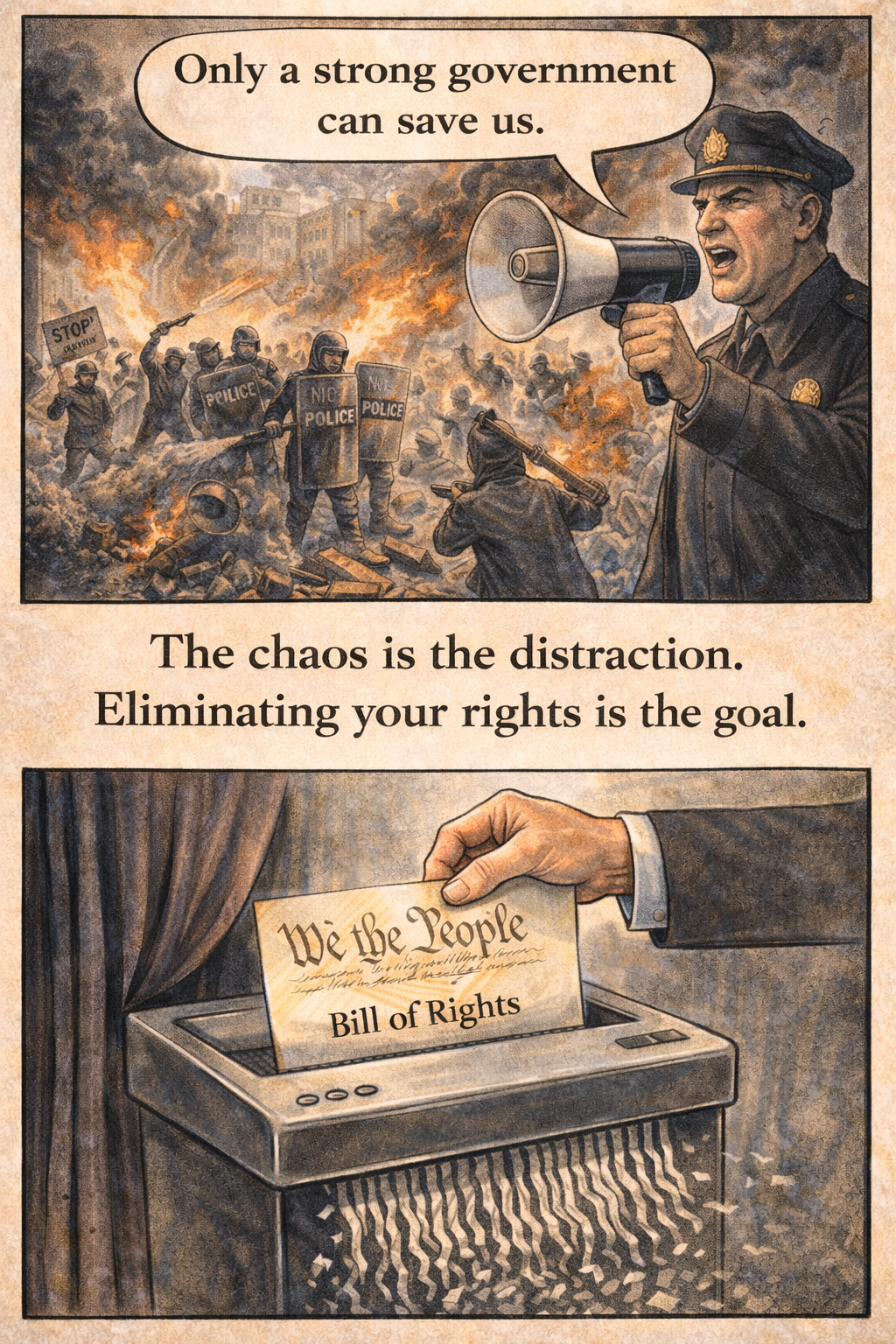
There’s a strange feeling you get when you sense something important is happening, but nobody around you seems to notice. It’s like watching a house quietly flood while everyone is in the living room arguing about the TV remote. You want to shake people and say, “Hey, the water is rising. Can we pay attention to that?”
Lately, America feels like that house.
We are surrounded by noise—headlines, scandals, outrage cycles, partisan street fights, culture-war flare-ups. There is always some big drama roaring across our screens that feels urgent and impossible to look away from. And while we’re staring at the spectacle, something quieter has been happening in the background: power is adjusting the rules, inch by inch, in ways that make ordinary people smaller and the state a little bigger.
Not through grand announcements. Not through sirens. Just through paperwork. Regulations. Investigations. “Policy changes.” Acts of enforcement that look neutral on paper but feel threatening in practice.
Take what’s happening when officials talk about “security” and “emergency measures.” On their own, those words sound reasonable. Who doesn’t want to feel safe? But watch what sometimes comes next: new rules about what can be said, who can gather, which reporters get access, which protests are “acceptable.” You don’t have to outlaw speech if you can quietly control the space where speech happens.
Or look at moments of unrest in the streets. People see anger, broken glass, fires, riot gear. Some see justified rage; others see frightening chaos. Either way, the camera stays locked on the clash. What we rarely see is the fine print that gets written afterward—expanded powers, looser standards for surveillance, new tools that are sold as temporary but rarely go away.
Elsewhere, investigations into critics, whistleblowers, and even lawmakers who challenge the line of authority reveal another quiet shift. When the mere act of speaking about what the law requires can trigger legal trouble, we’re not just debating policy anymore—we’re debating whether dissent itself is safe.
The thing is, none of this becomes the big national moment. It doesn’t drown out the election coverage, the celebrity drama, or the endless, exhausting left-versus-right firefights. The country is too busy watching the show.
And that is the part that should worry us. Governments don’t need tanks in the streets to shrink your freedoms. They can do it with subpoenas, reclassifications, speech guidelines, and search warrants that target reporters. They can do it by calling more and more things “secret,” by normalizing the idea that safety always requires one more exception, one more compromise, one more quiet surrender of something you were told you didn’t really need.
When you study history—not just ours, but anyone’s—you learn that liberty rarely disappears in a single act. Freedom dies of neglect. It erodes when people are too distracted to notice the edges being sanded off. It fades when the public assumes someone else will speak up, someone else will sue, someone else will object. And then, one day, there’s no “someone else” left.
But here’s the other side of the truth: Americans have never been passive for long. This country was built by people who said no, who refused silence, who believed that patriotism wasn’t about agreeing but about caring enough to argue, to question, to demand better. Our best chapters didn’t come from uniformity—they came from friction.
Maybe that’s the part we’ve forgotten in the noise. Patriotism doesn’t have to be loud or angry or performative. It can simply be paying attention. Asking questions. Watching the parts of government most people don’t bother to look at. Because if nobody watches, power will always test the limits.
And the limits matter. The lights don’t go out all at once. They go out room by room. The only way to stop that is to walk through the house together, flip the switches back on, and refuse to ignore what’s happening in the dark.