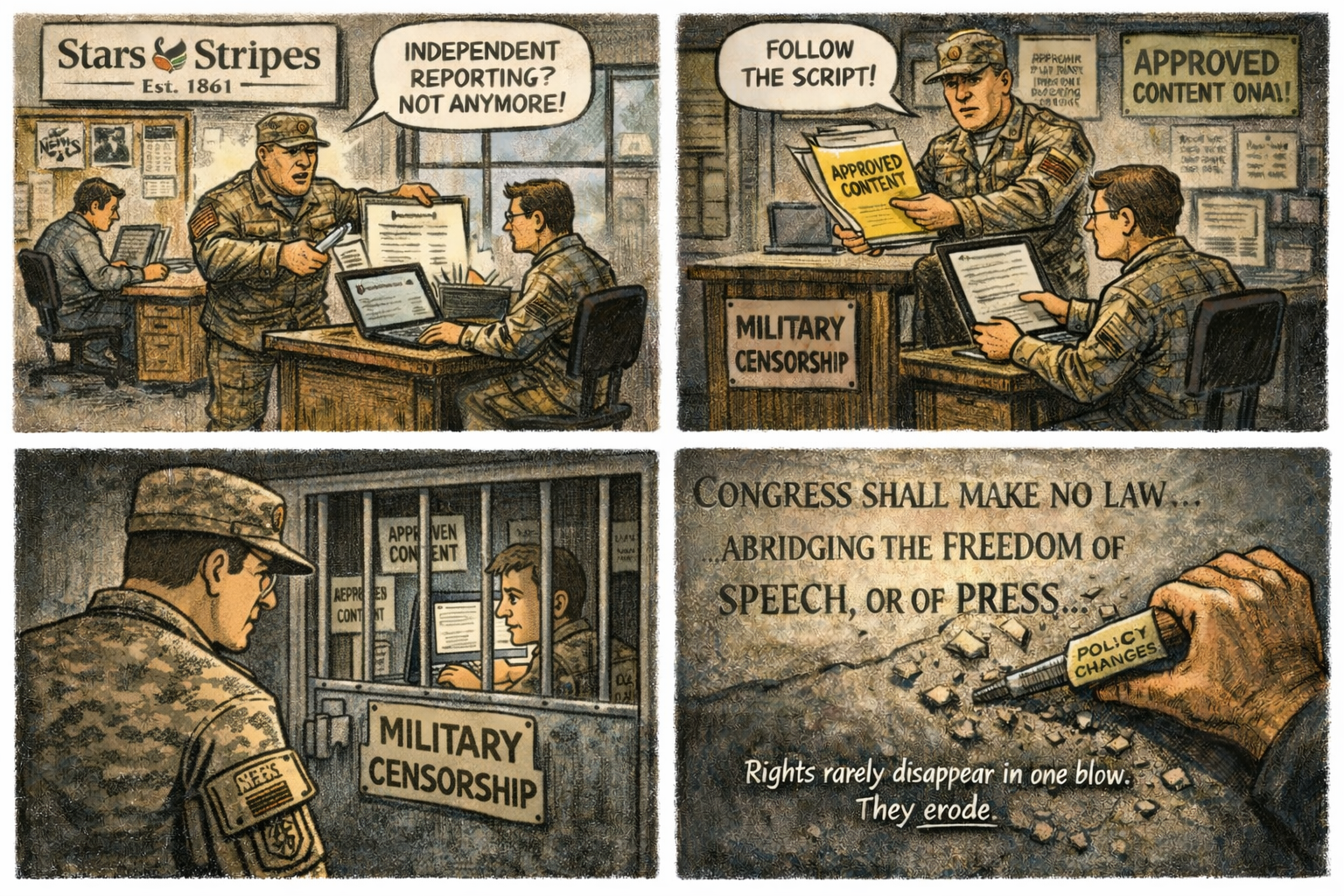
The slow death of a free press never announces itself with a gunshot. It comes in memos, hiring forms, and “policy updates.” It comes dressed as “modernization.” It comes smiling, insisting nothing fundamental is changing—while it quietly rearranges the wiring of democracy.
That’s exactly what’s happening right now with Stars and Stripes, the U.S. military’s historic newspaper.
For decades, Stars and Stripes has held a unique place in American life: funded in part by the Pentagon, but protected by Congress and tradition as a genuinely independent newsroom, operating under First Amendment principles even while its audience wears uniforms. It reported from Vietnam, Iraq, Afghanistan—often telling service members uncomfortable truths about their own institution. That independence is not an accident; it was hard-won after past attempts by military brass to meddle with coverage.
Now the Pentagon has decided it’s had enough of that independence.
In January 2026, the Defense Department announced that Stars and Stripes will be “refocused” away from so-called “woke distractions” and toward pure “warfighting” content—fitness, weapons systems, lethality, survivability. The plan, according to reporting and internal descriptions, is stark: remove Associated Press and Reuters content, pump the site full of Pentagon-generated material, and even move toward replacing civilian editors with active-duty service members. Roughly half of the outlet’s content is slated to come directly from the Defense Department itself.
That is not a newspaper. That is a house organ.
The timing isn’t random, either. Just days before the “refocusing” announcement, The Washington Post revealed that job applicants at Stars and Stripes were being asked how they would help advance President Trump’s policy priorities—a de facto political loyalty test baked into hiring for a supposedly independent news outlet. Management publicly claimed surprise; critics saw the obvious through-line: align the newsroom with the ruling administration, or keep it out. When you decide only the ideologically reliable get through the door, you are not hiring journalists. You’re curating mouthpieces.
Zoom out, and the pattern gets darker.
In 2025, the Pentagon rolled out new press rules demanding that reporters pledge not to use “unauthorized” material—even if it’s unclassified—or risk losing access. Major outlets from CNN and Fox News to The New York Times and The Washington Post refused to sign, forfeiting their Pentagon press passes rather than submit to what they described as a direct threat to press freedom. These rules tried to turn access into obedience: if you want to ask questions in this building, you must agree not to publish what we don’t want you to see.
Now, in that same building’s shadow, the last semi-independent newspaper for service members is being slowly hollowed out and filled with government copy.
Press-freedom advocates like PEN America are warning that the effort to control Stars and Stripes “threatens press freedom” and violates the spirit of Congress’s guarantees of editorial independence. The paper’s own ombudsman has called the Pentagon’s plans “contrary to the news organization’s mission.” When the people whose job it is to protect credibility start sounding the alarm, it’s usually because the fire is already in the walls.
This is how you erase the First Amendment without ever touching the text of the First Amendment.
You don’t have to outlaw speech if you can rig who gets hired, starve independent reporting of resources, replace it with sanitized “warfighting stories,” and surround the whole apparatus with loyalty oaths and access rules. You don’t have to ban a free press if you can turn it into a dependent press—afraid of losing funding, credentials, or even its existence if it steps out of line.
The First Amendment is just ink on parchment unless there are real, breathing institutions willing to test its limits: reporters who print what commanders don’t want printed, editors who say no to political litmus tests, publishers who accept the cost of independence. Stars and Stripes has been one of those institutions for generations of Americans in uniform.
Turning it into an arm of the Pentagon isn’t just a programming change. It’s a warning.
Because if the government can take a newspaper that Congress itself shielded as a “First Amendment newspaper” and quietly pull its spine out—under the cover of buzzwords like “modernization” and “morale”—what can’t it do to the rest of the media ecosystem?
The lights don’t go out all at once. They go out room by room, outlet by outlet, until one day you wake up and realize that the only stories left are the ones someone in power has decided you’re allowed to hear.