I know why people voted for Donald Trump.
He heard people. He said the things others wouldn’t. He sounded like someone willing to take action on the stuff that’s been weighing America down for years.
That mattered.
For a long time, a lot of folks felt invisible—worked hard, played by the rules, and still fell behind. Prices went up. Jobs felt shaky. Healthcare felt like a gamble. Politicians kept smiling and telling us everything was fine when it clearly wasn’t. When Trump said the system was rigged, it didn’t sound crazy. It sounded like the truth finally being said out loud.
But here’s the part that’s harder to face.
Somewhere along the way, being heard got confused with being helped.
Trump is very good at recognizing pain. He knows how to name it, point at it, and turn it into energy. Anger. Loyalty. Hope. But recognizing pain isn’t the same thing as relieving it. And after years of constant urgency, a quiet question starts creeping in—usually late at night, when the noise dies down:
Why does everything still feel so heavy?
Think back over the last few years. Not the headlines—your life.
Has it felt calmer?
More secure?
Less fragile?
Or has it mostly felt like one long emergency?
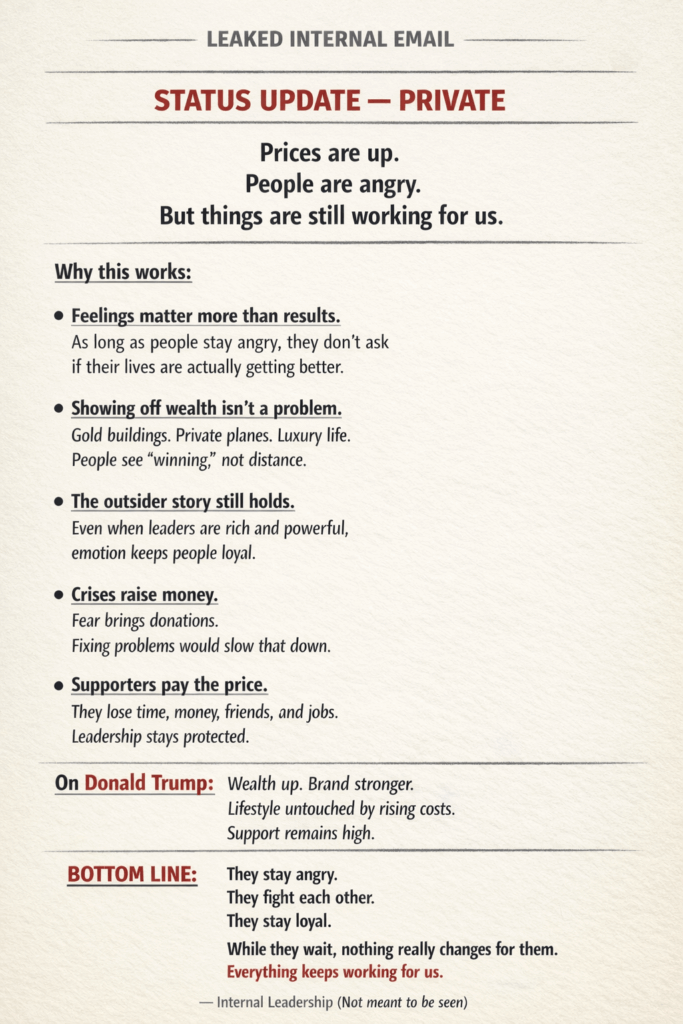
There’s always been a crisis. Always something about to be taken from you. Always an enemy. Always a reason you can’t look away. That constant pressure does something to people. It keeps your heart rate up. It keeps you focused on survival. And when you’re stuck in survival mode, you stop asking for timelines. You stop asking for proof. You tell yourself hanging on is enough.
That’s not accidental.
A crisis that never ends isn’t just a warning—it’s a system. Permanent crisis keeps people emotional. Emotional people don’t step back and measure outcomes. They stay loyal to the fight itself, even when the fight doesn’t seem to change their day-to-day reality.
While all that was happening, something else was happening too.
Trump wasn’t stuck in crisis. His lifestyle didn’t tighten. His stress didn’t show. His brand grew. His fundraising surged. Every new emergency came with another email asking for money. Every threat became proof that the battle had to continue. Fear didn’t slow things down—it powered them.
That’s when a lot of people start feeling something they can’t quite name. Not anger. Not jealousy. Distance.
Because the life being lived at the top doesn’t look like the life being lived by the people carrying all that stress. Gold buildings. Private planes. Constant protection. That doesn’t look like someone wondering whether they can afford a doctor’s visit or how long their savings will last.
And then there’s the cost.
It’s not Trump who paid it.
It’s the friendships that went quiet.
The family dinners that turned tense.
The nights spent arguing online instead of resting.
The money donated because it felt like the only way to matter.
Supporters carried the emotional weight. Trump stayed insulated. When things didn’t work, there was always someone else to blame. Sabotage. The media. The courts. Traitors. Accountability never landed because the crisis always moved on before it could.
That’s how you know this isn’t really about solving problems.
Real leadership aims for stability. It tries to make itself less necessary over time. It wants people to breathe again. Permanent crisis does the opposite. It keeps people dependent, reactive, and exhausted—always waiting for the next moment when things will finally turn around.
This doesn’t mean the anger was wrong. It wasn’t. The pain was real. The system is tilted toward the powerful. Working people do get the short end of the stick.
What’s worth asking now is whether being kept in a constant state of emergency actually honored that pain—or quietly used it.
Because after all this time, one question won’t go away:
If someone was truly taking action on the things keeping America down, wouldn’t life feel at least a little lighter by now?
If the crisis never ends, the leader never pays the price, and the people never feel real relief—then maybe the crisis isn’t the problem.
Maybe it’s the product.
And maybe the hardest realization isn’t that people were wrong to hope—but that hope got turned into fuel for a system that never planned to let things settle, because settling would mean the noise stops, the money slows, and the questions finally get asked.