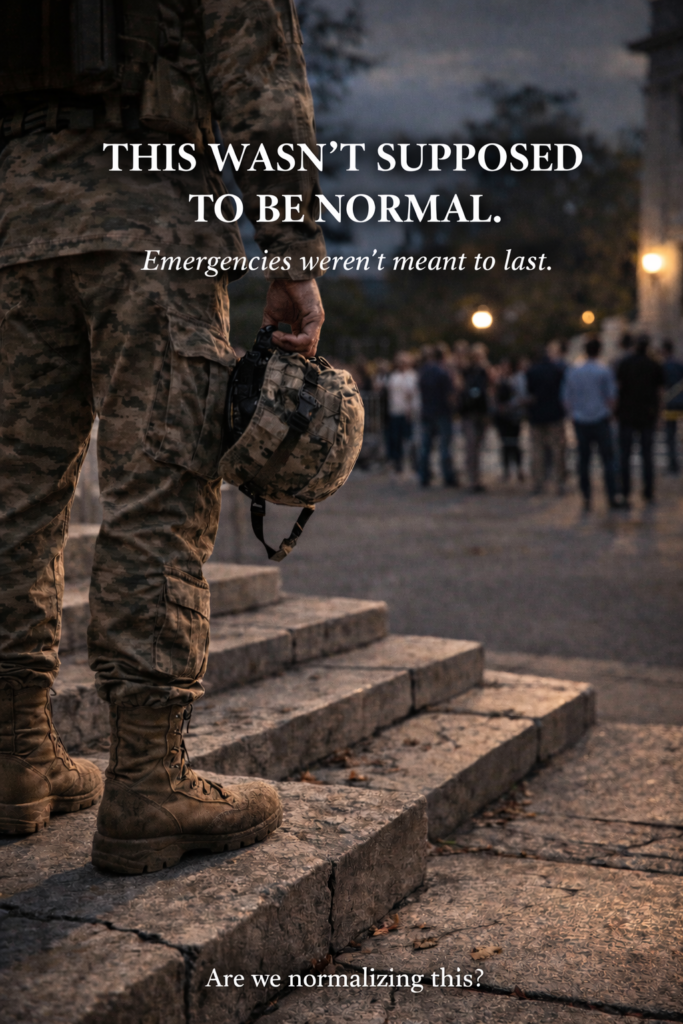
There’s a certain image most Americans carry in their minds when they think of the National Guard.
It’s a Guard member in muddy boots filling sandbags during a flood. It’s soldiers handing out water after a hurricane. It’s neighbors in uniform standing shoulder to shoulder with their own communities after a wildfire tears through town.
For generations, the Guard has represented something uniquely American: citizen-soldiers who live among us, work beside us, and step forward when disaster hits.
But lately, that image feels different.
Over the past several years, National Guard units have increasingly been deployed into politically tense environments — protests, election security support, and border operations. These deployments are legal. Governors have broad authority to activate their state Guard units, and presidents can federalize them under certain conditions.
That isn’t new.
What feels different to many Americans is the frequency — and how familiar the sight of uniforms in civic conflict has become.
What the Guard Was Designed to Be
The National Guard traces its roots to colonial militias. Today, it operates under a dual system: typically under the authority of state governors, but subject to federal activation when necessary. Guard members take the same oath as active-duty service members — to support and defend the Constitution of the United States.
Traditionally, Guard deployments at home have centered on emergencies: natural disasters, sudden unrest, infrastructure failures, or short-term security needs.
The key word has usually been temporary.
The United States has long maintained both legal and cultural boundaries between military power and civilian political life. After Reconstruction, Congress passed the Posse Comitatus Act of 1878, which restricts federal troops from carrying out routine civilian law enforcement duties inside the United States, except where authorized by law.
The National Guard, when operating under state authority, is not bound by Posse Comitatus in the same way federal active-duty forces are. Governors can use Guard units to support law enforcement during emergencies. That authority has existed for decades.
Still, boundaries matter — even when the actions are lawful.
A Shift in Visibility
In 2020, more than 30 states activated National Guard units during widespread protests and unrest. In 2021, Guard forces surged in Washington, D.C., following the January 6 attack on the U.S. Capitol, with a smaller contingent remaining on duty until late May of that year.
In recent years, several governors have also deployed Guard units to assist with border operations, sometimes for extended periods.
Each of these deployments followed legal channels. Each had its own stated justification.
But taken together, they reflect a pattern of Guard units appearing more frequently in politically charged settings rather than solely in response to natural disasters.
The Guard was never intended to be a routine backdrop to civic disagreement. Its presence carries symbolic weight. Uniforms communicate seriousness, authority, and the power of the state — even when the mission is limited to logistics or support.
When soldiers stand near government buildings, protest lines, or election infrastructure — even in non-law-enforcement roles — it can change the atmosphere.
Not necessarily for the worse. But undeniably, it changes it.
The Burden on the Guard
This is not a criticism of Guard members themselves.
They are teachers, mechanics, nurses, small-business owners. They volunteer to serve. Many join out of a desire to protect their communities and respond to disasters.
When deployments place them in the middle of political tension, they become visible symbols in moments of national division. That symbolic weight is not something they created — but it is something they must carry.
Why Boundaries Matter
America has never lacked disagreement. Our system was built for argument.
What has protected it over time are clear structures and guardrails — lines that separate civilian institutions from military force.
Most recent Guard deployments have been lawful. The deeper question isn’t legality.
It’s cultural.
Are we becoming more comfortable seeing military uniforms as part of everyday political life? And if so, what does that mean for how we define “emergency” going forward?
Democracies rarely shift in a single dramatic moment. More often, they evolve through normalization. What once felt exceptional becomes routine.
The National Guard was created to protect communities in crisis. If civic conflict increasingly qualifies as crisis, we owe it to ourselves — and to those who serve — to have an honest conversation about where the lines should stand.
Not out of panic.
But out of respect for the boundaries that have long helped hold the system together.