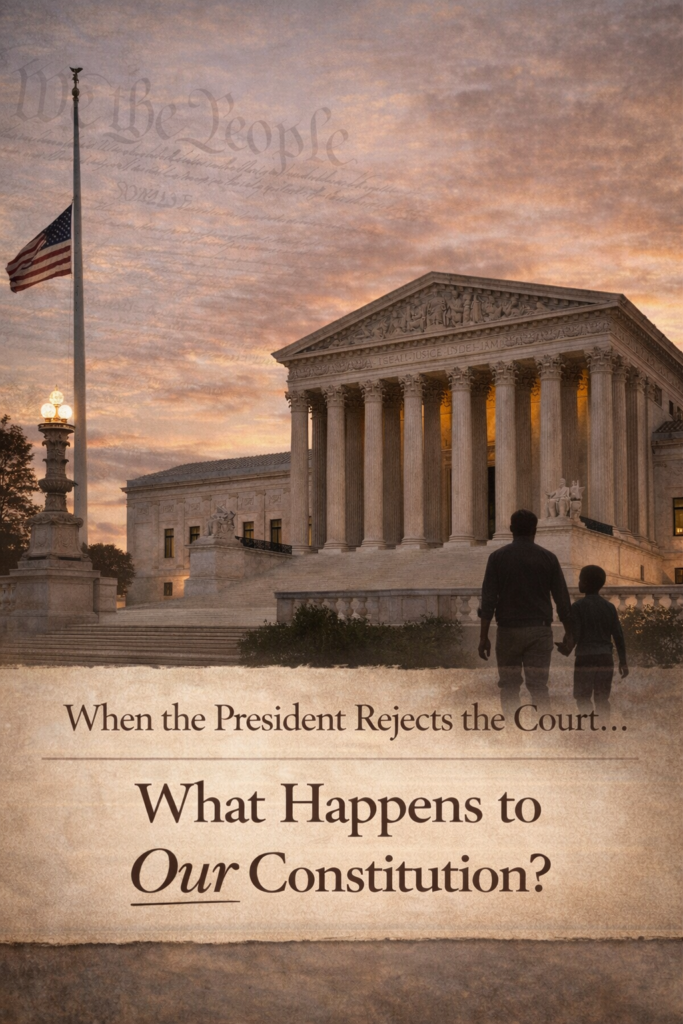
When a president loses in court, Americans expect disappointment. Maybe even anger. What we don’t expect — or at least what we shouldn’t — is open hostility toward the very system that keeps our country balanced.
Yesterday, after the Supreme Court of the United States ruled against him, Donald Trump didn’t just say he disagreed. He publicly attacked the Court, questioned the motives of the justices, and suggested the ruling was politically driven instead of rooted in constitutional law.
That matters. Not because presidents aren’t allowed to disagree. They are. But because of what it signals when the person sworn to uphold the Constitution openly casts doubt on one of its co-equal branches of government.
The American system was designed with friction built into it. The founders understood human nature. They knew power can swell, pride can flare, and leaders can convince themselves they’re right. So they built guardrails. Congress makes the laws. The president enforces them. The courts interpret them. That balance — laid out in the U.S. Constitution — isn’t symbolic. It’s structural.
When a sitting president suggests the Supreme Court’s ruling is illegitimate simply because it went against him, it sends a message that the rules only count when they produce the “right” outcome. That’s not how constitutional government works. The whole point of judicial review is that no officeholder — not a mayor, not a governor, not even a president — is above the law.
For many Americans, especially those who grew up valuing order and accountability, this feels personal. We tell our kids that if they lose a game, they shake hands and try again. If they disagree with a teacher, they follow the proper channels. You don’t tear down the authority of the referee because you didn’t like the call.
Presidents have every right to voice concern. They can argue that the Court misinterpreted the law. They can advocate for legislative fixes. But there’s a difference between criticism and corrosion. When criticism becomes a broad claim that the judiciary itself is compromised, that begins to chip away at public trust.
And trust is everything.
The Supreme Court doesn’t have its own enforcement arm. It relies on the executive branch — the president — to respect and carry out its rulings. If the president undermines the Court’s legitimacy in the eyes of millions, the foundation weakens. The Constitution depends on each branch honoring limits, even when it’s inconvenient.
This isn’t about left or right. Plenty of Americans on both sides have bristled at Supreme Court decisions over the years. But historically, presidents have understood that the office carries a responsibility bigger than personal frustration. The health of the system comes first.
There’s a deeper issue here that many everyday Americans recognize instinctively. A lot of people already feel institutions don’t work the way they should. They feel disconnected from Washington. When the president himself questions the integrity of the highest court, it reinforces a dangerous idea: that our checks and balances are just political tools, not constitutional safeguards.
The Constitution isn’t self-executing. It survives because leaders — especially presidents — choose to respect its boundaries. It survives because Americans believe the system, imperfect as it is, still functions on principle.
Leadership means accepting limits. It means absorbing losses without burning down the framework that made the contest possible in the first place.
When a president responds to an unfavorable Supreme Court ruling by attacking the Court itself, it doesn’t just escalate political tension. It erodes something quieter but more vital: the shared understanding that the rule of law stands above any one individual.
The Constitution is only as strong as our willingness to defend it — especially when it tells us “no.”