There are moments when a country is tested not by foreign enemies or sweeping declarations, but by a single gunshot in the cold, a shaky video recorded by a stranger, and a family that will never be whole again.
In Minneapolis, a man went to a protest. He carried a sign. He carried his beliefs. And yes—he carried a firearm, legally, under the laws of the state he lived in and the Constitution he trusted.
By the end of that night, he was dead.
Federal agents said they feared for their safety. That explanation exists in the public record. So does something else: video filmed by bystanders, footage that appears to contradict parts of the official account. The Associated Press reported that this gap between what was said and what was seen ignited public outrage and raised serious questions about transparency, oversight, and the use of deadly force by the government against a civilian.
This is not rumor. This is not ideology. This is fact.
A Right Is Not a Threat
The Second Amendment is not obscure. It is not hidden. It is not conditional on good behavior or government approval. The U.S. Supreme Court affirmed it in District of Columbia v. Heller. Minnesota law permits firearm carry with a valid permit. There is no dispute on this point.
What should shake us is this simple truth:
A man exercised a constitutional right—and it may have contributed to his death.
Carrying a firearm is not a crime. Protesting is not a crime. Criticizing the government is not a crime.
And yet, a lawful act appears to have been treated as a lethal provocation.
This is how rights begin to die—not through repeal, but through reinterpretation. Not through legislation, but through fear.
When the State Investigates Itself
After the shooting, Minnesota authorities were reportedly restricted from immediately conducting an independent investigation. That fact matters.
When the government uses lethal force, the government should not control the timeline or scope of accountability. Transparency is not a courtesy extended after public pressure—it is the cost of wielding power in a constitutional system.
Across political lines, Americans have long agreed on one principle: no agency should be above scrutiny. When scrutiny is delayed, trust erodes—not because citizens are cynical, but because history has taught them what happens when power is left unchecked.
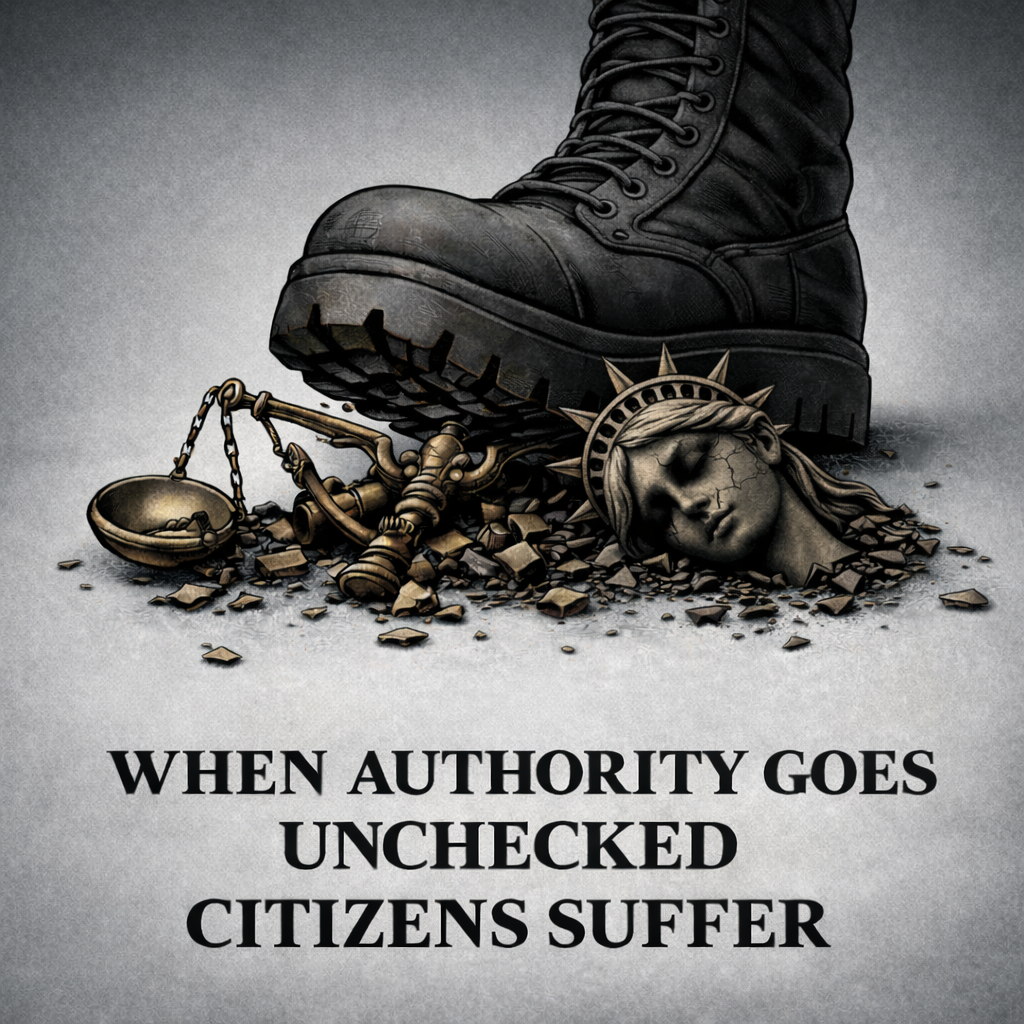
Authoritarian systems do not begin by abolishing rights. They begin by shielding themselves from oversight.
Protest Is Not a Crime
In the days that followed, people gathered to demand answers. The Associated Press documented federal agents using pepper spray and other crowd-control measures against demonstrators responding to the killing.
The message, intended or not, was unmistakable: grief would be managed, dissent would be contained, and questions would be answered later—if at all.
But protest is not a threat to democracy. It is one of its safeguards. The First Amendment exists precisely for moments when the public challenges the government’s use of force and demands accountability.
When protest is treated as danger rather than dialogue, the ground shifts beneath a free society.
The Dangerous Precedent
The most unsettling question raised by this case is not whether one officer made a tragic mistake. Investigations exist to answer that.
The danger lies in the precedent being tested:
- If lawful firearm possession can be reframed as justification for lethal force
- If constitutional rights dissolve under perceived tension
- If federal authority can limit independent review after killing a civilian
- If video evidence must compete with official narratives for legitimacy
Then the Constitution ceases to be a restraint on power and becomes a symbolic document—revered in theory, ignored in practice.
That is not speculation. That is history.
A Bipartisan Warning
This should concern everyone.
Those who value the Second Amendment should be alarmed that lawful carry may be treated as inherent threat.
Those who value the First Amendment should be alarmed that protest meets chemical response.
Those who value law and order should be alarmed when transparency falters.
Those who value limited government should be alarmed when federal power expands without immediate accountability.
These concerns do not belong to a political party. They belong to the Constitution.
When Rights Become Optional
A nation does not lose its freedom when rights are erased from law books. It loses freedom when rights are honored only when convenient—when they protect people in theory but fail them in moments of fear.
The man killed in Minneapolis cannot be brought back. But the principles at stake are still alive—if they are defended.
One day, someone will ask how it happened—how a nation built on rights learned to live without them. The answer will not be found in a single law or a single shot, but in moments like this, when a lawful citizen died, the truth was debated, and the country chose comfort over courage. Freedom rarely disappears in chains. More often, it slips away while everyone is arguing whether it was ever really there at all.