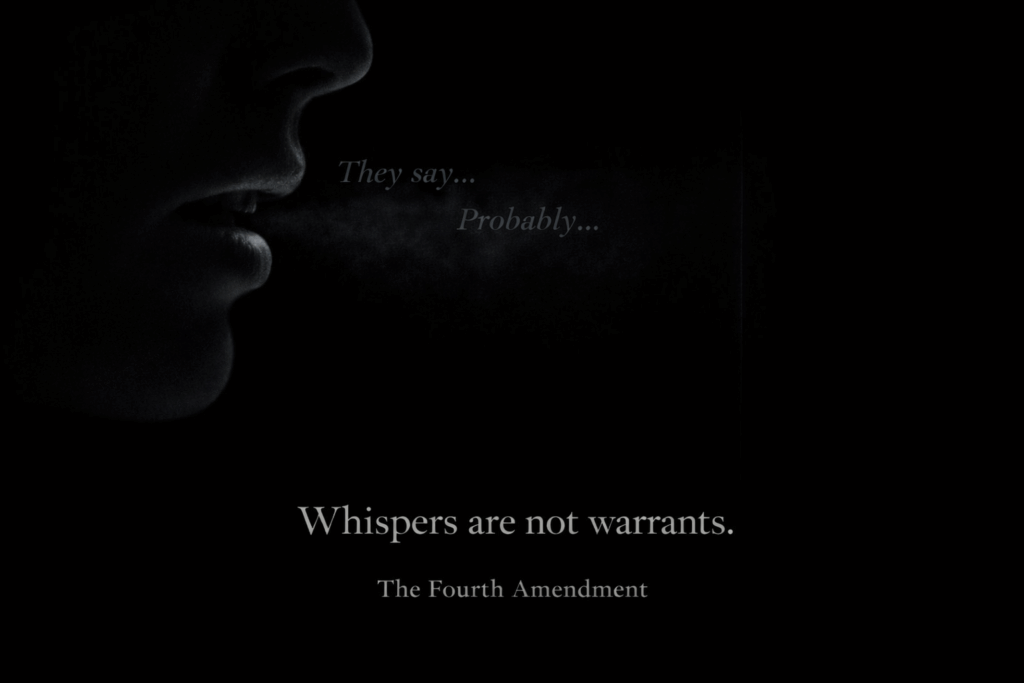
There are some freedoms that shout.
They march, they chant, they wave flags.
And then there are freedoms that whisper.
The Fourth Amendment is a whisper.
It does not announce itself in moments of triumph. It shows up at night, when the house is quiet. When a parent checks on a sleeping child. When a door is locked not out of fear, but out of dignity. When someone exhales because, for now, they are left alone.
It is only 54 words long. No grand speeches. No soaring poetry. Just a simple promise:
that you are not a thing to be searched at will,
that your life is not an open drawer,
that the government must pause before crossing your threshold and ask—may I?
That pause matters more than we realize.
The Human Story Behind the Amendment
The Fourth Amendment was born from pain. Before it existed, British agents could barge into homes using “general warrants,” searching wherever they pleased, for whatever they wanted, with no explanation required. Homes were ransacked. Personal letters read aloud. Private lives turned inside out.
The Founders didn’t write the Fourth Amendment because they distrusted law enforcement. They wrote it because they understood human power. They knew that even well-intentioned authority, when unchecked, grows careless with other people’s lives.
They understood something timeless:
that fear makes us rush,
that certainty makes us cruel,
and that without rules, power forgets the faces it affects.
So they drew a line.
Not to weaken the state—but to protect the soul of the people.
Why the Right and the Left Both Need It
For those who believe deeply in liberty, limited government, and individual responsibility, the Fourth Amendment is sacred ground. It says the government does not own you. It says your home is not an extension of the state. It says freedom begins at your front door.
It is the embodiment of self-reliance and personal sovereignty.
No search without cause.
No intrusion without justification.
No power without restraint.
For those who believe deeply in equality, civil rights, and protection from abuse, the Fourth Amendment is a shield. History has shown—again and again—that surveillance and unchecked searches fall hardest on the vulnerable: minorities, dissidents, the poor, the unpopular.
It is the amendment that stands between “suspicion” and harassment.
Between “investigation” and intimidation.
Between law enforcement and profiling.
Different philosophies. Same protection.
The Fourth Amendment does not ask who you voted for.
It asks whether power has earned the right to enter your life.
The Tears We Don’t See
Most violations of the Fourth Amendment don’t make headlines.
They happen quietly.
They happen when someone’s phone is searched and suddenly their private thoughts are no longer theirs.
When a car is stopped not because of danger, but because of a hunch.
When a family watches strangers move through their home, touching their things, misunderstanding their lives.
And even when nothing incriminating is found, something is still taken.
Trust.
Safety.
The sense that your inner world belongs to you.
People rarely cry in courtrooms over search procedures. But they cry later—at home—when they realize how exposed they felt. How small. How powerless.
The Fourth Amendment exists for those tears.
Privacy Is Not Secrecy
One of the cruelest misunderstandings of our time is the idea that privacy only matters if you have something to hide.
But privacy is not about hiding wrongdoing.
It’s about protecting humanity.
We close bathroom doors not because we are criminals.
We keep diaries not because they are dangerous.
We whisper to people we love because intimacy requires space.
A society that demands total access to its people is not a safer society. It is a colder one.
The Fourth Amendment says: You are allowed an inner life.
A Fragile Line Worth Defending
Technology has made this amendment more important—not less. Our homes now fit in our pockets. Our movements are logged. Our thoughts are typed. Our relationships mapped.
The temptation to trade privacy for convenience, or security, or certainty is enormous. And sometimes that trade feels reasonable. Sometimes it feels necessary.
But the Fourth Amendment reminds us that once the line moves, it rarely moves back.
It asks us—gently, urgently—to slow down. To demand reasons. To require warrants. To insist that power explain itself before touching what is ours.
That insistence is not radical.
It is patriotic.
The Quiet Miracle
The Fourth Amendment does not promise perfection. It does not prevent every abuse. It does not stop every injustice.
What it does is more fragile—and more beautiful.
It creates a moment where the state must stop and acknowledge your humanity.
A moment where the answer is not “because we can,” but “because we must.”
A moment where freedom lives—not in noise, not in outrage—but in restraint.
And one day—without warning—you may be grateful for a right you never thought about. Not because you are guilty, but because you are human. Because you love someone. Because you grieve. Because your life is messy, private, unfinished. The Fourth Amendment is there for you on your most ordinary days and your most vulnerable ones. It is there when you are misunderstood, when the world is afraid, when power is impatient. It is the hand on the door that says wait. It is the breath before harm. It is the difference between being governed and being owned. And if we lose that pause—if we teach ourselves not to feel when it disappears—we will not just lose a legal protection. We will lose the quiet, sacred idea that a person’s life is worthy of respect even when no one is watching.