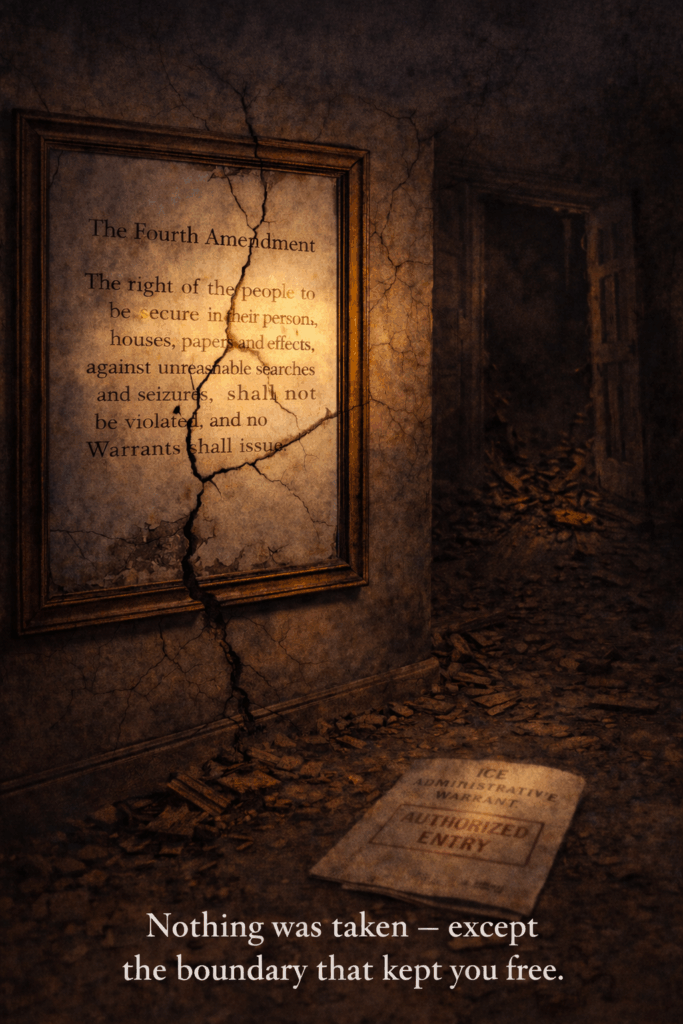
Imagine waking up to fists pounding on your front door at dawn. No judge. No court order. No neutral authority saying this intrusion is justified. Just armed agents of the state telling you they have decided—on their own—that they may enter your home. This is not a distant authoritarian nightmare. This is happening now. And once a government claims the power to break into homes without judicial approval, freedom is no longer a right—it is a favor.
A free society is defined by limits on government power. One of the oldest and most important of those limits is simple: the state does not enter your home by force unless an independent judge authorizes it. That line exists because the home is the final refuge from state power. When that refuge disappears, everything else becomes negotiable.
The recent use of administrative warrants to justify forced home entry crosses that line. An administrative warrant is not reviewed by a judge. It is signed by the same agency that wants to carry out the arrest. The government is no longer asking permission—it is granting it to itself. That may sound procedural or technical, but in reality it is the removal of a critical brake on power.
This is how freedom is taken—not all at once, but quietly, through “exceptions,” memos, and justifications that sound reasonable until you imagine yourself on the receiving end.
Freedom means you do not have to trust the government’s intentions. It means the government must prove, to someone independent, that it has the right to disrupt your life, frighten your family, and violate your private space. Judicial warrants exist because history has shown—over and over—that unchecked authority will eventually be abused. Not always immediately. Not always deliberately. But inevitably.
When the state can force its way into a home without a judge’s approval, every person lives one policy change away from being next. The category may change. The justification may shift. But the precedent remains. Power, once taken, does not voluntarily return itself to its cage.
This is especially dangerous because it normalizes fear. People begin to wonder whether opening their door is safe. Whether asserting their rights will escalate a situation. Whether asking for a judge’s warrant will even matter anymore. That uncertainty is not a side effect—it is the mechanism by which freedom erodes.
A society where people fear their own government is not free, even if elections still exist.
Supporters of expanded enforcement often say this only affects “certain people” or “those who broke the law.” That argument misunderstands how rights work. Rights are not rewards for good behavior. They are barriers against power. Once the government proves it can bypass those barriers for one group, the barrier itself has already failed.
History is unambiguous on this point. General warrants—documents that allowed authorities to enter homes without specific judicial approval—were tools of oppression. They were used to intimidate, silence, and control populations. The Fourth Amendment was written precisely to prevent their return. It was not written for convenience. It was written out of fear—fear of what governments do when no one stops them.
There is also the human cost. Forced home entry is inherently dangerous. Doors are broken. Guns are drawn. Families are traumatized. Mistakes happen. Addresses are wrong. Information is outdated. People panic. That is not hypothetical; it is the predictable outcome of granting violence-backed authority without sufficient oversight.
And yet the most lasting damage is psychological. When people internalize that their home is not truly theirs, something fundamental changes. Privacy becomes conditional. Safety feels fragile. Citizenship feels provisional. That is not freedom—it is quiet submission.
A free people demand friction. They demand judges, paperwork, oversight, and accountability. Not because they oppose enforcement, but because they understand that power must be slowed down to be kept honest.
The moment we accept that the government may enter homes on its own authority, we accept a smaller, weaker version of freedom. One where rights exist on paper but vanish at the door.
And once that door is kicked in, it is very hard to rebuild what was lost.