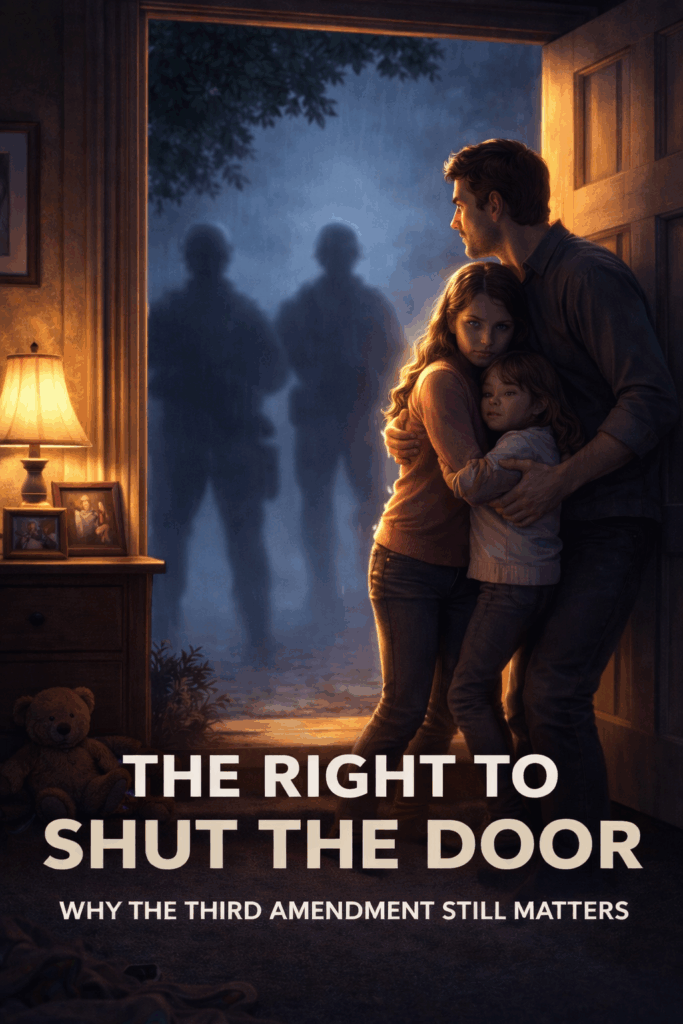
The Third Amendment to the U.S. Constitution is short. Just one sentence. No dramatic language. No bold promises. Yet hidden inside it is one of the most personal ideas in American freedom: your home belongs to you, not the government.
When the Founders wrote this amendment, they weren’t thinking in theory. They were thinking about real families. Real fear. British soldiers had been forced into colonists’ homes before the Revolution. They slept in their beds. Ate their food. Watched their children. Armed strangers lived under the same roof as mothers, fathers, and grandparents who had no power to say no.
Imagine being told that your home—your only safe place—was no longer private. Imagine trying to sleep knowing that the people occupying your house represented a government that did not care about your voice or your consent. The door still stood, but it no longer protected you.
The Third Amendment was written to make sure that never happened again.
At its heart, the amendment is about boundaries. It draws a clear line and says: even the government must stop here. Even authority must knock. Even power must ask permission.
That idea still matters today, even though most people rarely talk about the Third Amendment. It matters because government power has not disappeared—it has grown more complex. Authority no longer comes in red coats and marching lines. It comes with uniforms, paperwork, vehicles, and phrases like “temporary,” “necessary,” or “for public safety.”
And that’s why the Third Amendment still speaks to us.
Your home is more than a building. It’s where you cry without being watched. Where you argue, forgive, pray, rest, and feel human. It’s where you can take off the mask you wear for the outside world. If the government can enter and occupy that space without consent, something deep breaks—not just legally, but emotionally.
Now consider a future without the Third Amendment’s principle.
Without it, the idea that homes are completely off-limits to government occupation would weaken. Even if it didn’t happen often, the possibility would exist. During large federal enforcement actions—like immigration operations—officials might argue that nearby homes could be used temporarily for housing personnel, monitoring, or staging. Families might be told it’s legal. That it’s required. That it’s “only for a little while.”
And even if this power were used rarely, fear would spread quickly.
People would start to wonder: Could it happen to me?
Would opening your door feel safe anymore?
Would your home still feel like a refuge—or like a place that could be taken at any moment?
The Third Amendment helps prevent that fear from taking root. It reinforces the idea that law enforcement and government authority must operate around civilian life, not inside it. It reminds the state that people are not tools, and homes are not resources to be claimed.
More than anything, the amendment protects dignity.
It protects the right to shut your door at night and know that no one can cross that threshold without your permission or the law clearly standing behind it. It protects the idea that power should serve people—not live among them, watch them, or intimidate them in their most vulnerable spaces.
Freedom isn’t always loud. Sometimes it doesn’t march or shout. Sometimes it’s quiet. Sometimes it’s just a sentence that says: This place is yours.
And that is why the Third Amendment still matters today.