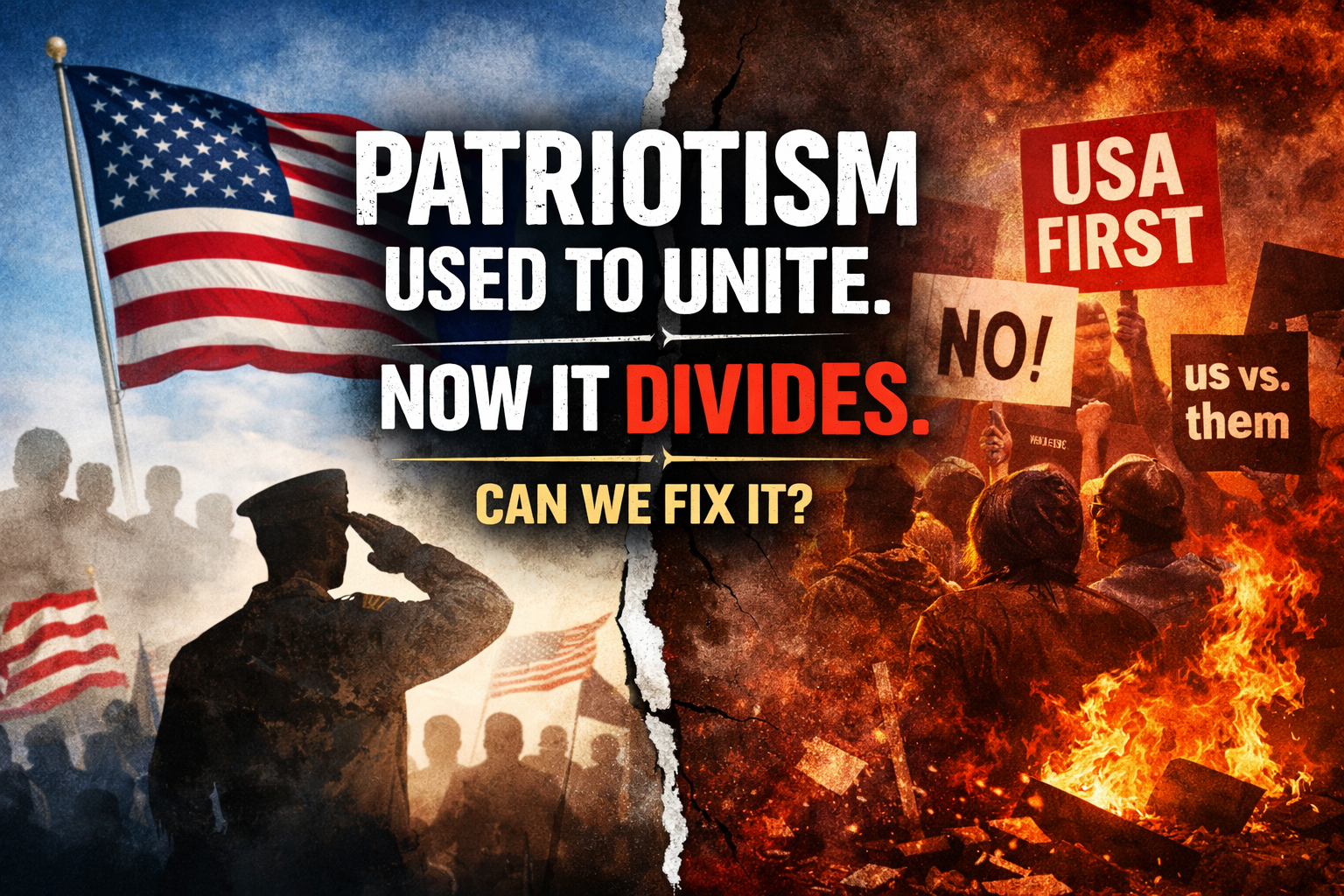
There’s a time many people remember—sometimes dimly, sometimes vividly—when patriotism felt like a shared language. You could stand beside neighbors, coworkers, strangers, and feel an unspoken sense of belonging. It wasn’t about who was right or wrong, who won or lost, or who had the better argument. It was about being part of something larger than yourself, something imperfect but worth caring for.
Today, that same word—patriotism—can spark a hundred different reactions. It can ignite pride, anger, suspicion, or even exhaustion. People hear the word and imagine different symbols, different histories, different futures. Instead of being a bridge, patriotism can feel like a battlefield. The same idea that once drew us closer to one another now sometimes carves fault lines between us.
This fracture didn’t happen overnight. Our country has always had disagreements—deep ones. What changed is not the existence of those disagreements, but our relationship to one another through them. We’ve learned to assume that someone expressing love for their country must be implying something about those who disagree. We’ve learned to read motives into gestures that used to require no translation. A hand over a heart, a flag in the yard, a critique of national history—each can feel loaded in ways they didn’t before.
For many, patriotism used to be less about proving loyalty and more about participating in a shared experiment: the ongoing attempt to build a society that reflects our best values. It held space for both pride and critique. You could love your country dearly and still want it to grow or change. You could challenge it because you cared about it. That tension—between loving and questioning—was not a sign of disunity. It was a sign of life.
Now, we sometimes confuse disagreement with betrayal. Criticism can be mistaken for rejection. Pride can be mistaken for supremacy. We assume the worst about other people’s intentions before they have a chance to explain. And when distrust replaces curiosity, patriotism becomes less about shared identity and more about sorting ourselves into camps.
But here’s the quiet truth beneath all the noise: most people still care. They care deeply—often more deeply than they know how to express. They want their country to be good, fair, strong, compassionate, respected, and resilient. They want their children to inherit a place that protects them and offers them a chance. That desire itself is patriotic, even if we express it differently, even if we disagree about how to get there.
The tragedy is that we’ve begun to mistake difference for division. We forget that a democratic society has always been a chorus of contrasting voices. We forget that unity doesn’t mean uniformity, and that the strongest bonds are rarely forged through silence or sameness. They are built when people learn to wrestle with the future together—even when it’s uncomfortable.
We also underestimate how much we share. Almost everyone wants dignity. Almost everyone wants safety. Almost everyone wants opportunity. Almost everyone wants to feel like they belong to a story that matters. If patriotism once united us, it was because it told a story expansive enough for many people to find themselves inside it. When the story narrows, the unity narrows too.
So the question isn’t whether patriotism is good or bad, outdated or essential. The question is whether we can reclaim its human center. Can we allow patriotism to mean love, not proof? Can we make room for pride without erasing pain, and room for critique without assuming contempt? Can we build a version of love for country that doesn’t require winning an argument first?
None of that is easy. But it’s not impossible either. Every movement toward unity begins with the smallest possible gesture: seeing one another as fellow participants rather than opponents. Listening instead of labeling. Asking why instead of assuming. Remembering that shared belonging doesn’t require identical beliefs.
Patriotism does not have to divide us. It can still be something that calls us to our better selves—not because we always live up to our ideals, but because we believe they are worth striving for. To care for a country is to care for the people in it. It means trying, in a hundred imperfect ways, to hold on to each other even when the world seems determined to pull us apart.
Unity isn’t the absence of tension. It’s the decision to stay in the conversation. And perhaps, if we can choose that again, patriotism may yet become a force that knits us together rather than tears us apart.