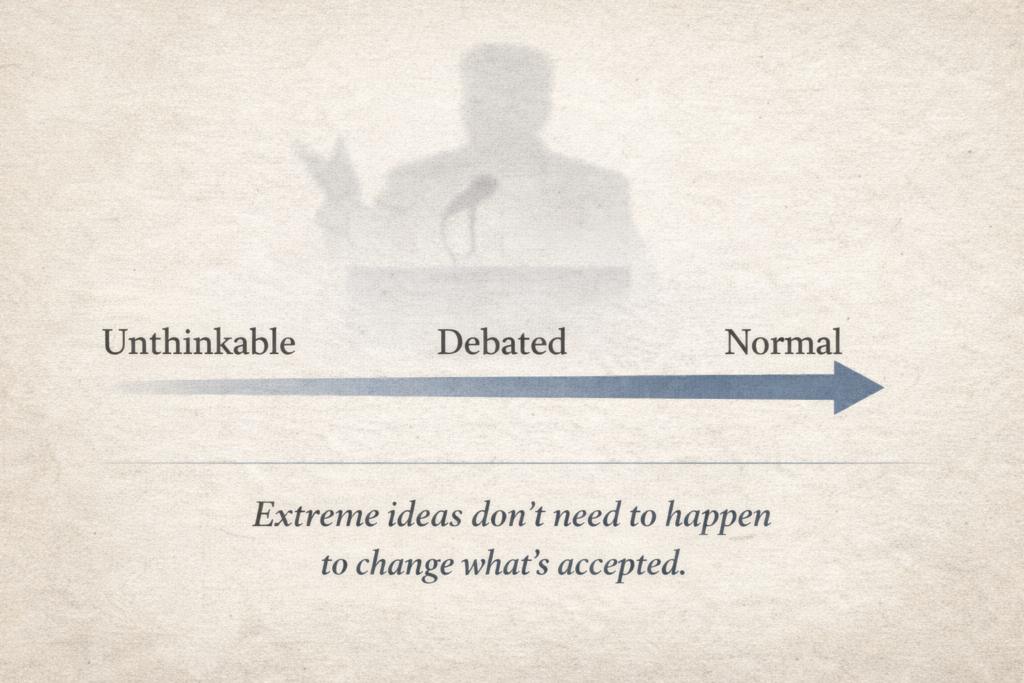
Most people heard the suggestion and brushed past it. A president floated the idea that the federal government “should take over” elections, and the reaction was predictable: he’s just talking, that’ll never happen, there are bigger things to worry about. That response is understandable—but it’s also risky. Because in a country like ours, rights don’t usually disappear through sudden moves. They erode when extreme ideas are introduced casually, when people get used to hearing them, and when power quietly shifts upward while everyone assumes the guardrails will hold. This moment doesn’t call for outrage or panic. It calls for attention—and for a steady commitment to keeping control of our elections where it belongs: close to the people.
When I first heard the comment, my instinct was the same as a lot of folks’. It sounded like noise in an already noisy political world. No proposal. No plan. Just words. But after sitting with it, that shrug started to feel like the wrong response—not because I expect an immediate takeover, but because this is often how lines move in American life: slowly, indirectly, and without much ceremony.
Extreme Talk Usually Has a Purpose
In everyday situations, when someone opens with an extreme position, it’s rarely because they expect to get exactly that. It’s a way of testing the room. A way of setting boundaries. A way of seeing how much resistance there will be.
Politics works the same way.
When Donald Trump suggested federal control of elections, it didn’t come with details or a timeline. It came as an idea placed on the table. And ideas floated by people with real power are never just idle thoughts. They’re signals.
That’s why, within days, 24 governors issued a joint statement condemning the idea as unconstitutional. Governors don’t usually move in unison unless they sense a real line is being approached. That reaction wasn’t about tone or personality. It was about structure.
What’s Really Being Negotiated
The most important thing to understand is this: the argument usually isn’t about the extreme idea itself. It’s about what follows.
Once something drastic is said out loud, smaller versions of it start to sound reasonable by comparison. Not a full federal takeover, maybe—but more centralized rules. More federal oversight. Less local discretion.
Each step can be defended on its own. Each one can sound practical or even sensible. But taken together, they all move power in the same direction—away from voters and closer to whoever controls the federal government at the time.
That’s the negotiation. And what’s being negotiated isn’t efficiency. It’s how much independence people are willing to give up.
Why Local Control Still Matters
Our election system isn’t perfect. It’s uneven, sometimes frustrating, and far from elegant. But it’s built that way for a reason.
Local and state control means no single person or administration runs everything. It means mistakes don’t automatically become national crises. It means disagreement doesn’t require a centralized fix. Power is spread out, and that makes it harder to abuse.
Centralizing elections—even gradually—changes that balance. And once power is concentrated, the question is no longer whether it can be misused, but when.
If you wouldn’t trust your political opponents with that kind of authority, then it’s worth asking why you’d want your own side to have it.
This Doesn’t Require Panic—It Requires Attention
There’s no need to assume the worst or sound alarms at every comment. But there is a need to stay alert.
Rights are rarely taken all at once. More often, they’re adjusted, narrowed, reinterpreted, and bargained over—usually with good intentions, usually in the name of fixing a real problem.
By the time people realize something fundamental has changed, it’s often already become routine.
What Defending Rights Looks Like in Practice
Defending democratic rights doesn’t have to be loud or angry. It mostly looks steady.
It looks like:
- Taking extreme ideas seriously, even when they’re framed casually
- Defending fair processes even when the outcome isn’t what you hoped for
- Paying attention to state and local offices, not just national figures
- Supporting election workers who do their jobs quietly and professionally
- Being cautious about “temporary” solutions that concentrate power
None of that makes headlines. But it’s how systems hold.
A Quiet Responsibility
The right to vote—and to have that vote counted fairly—wasn’t built on the assumption that leaders would always act in good faith. It was built on the understanding that power needs limits.
Those limits only matter if people are willing to defend them calmly, consistently, and before a real crisis forces the issue.
This moment doesn’t call for fear. But it does call for resolve.
Because when extreme ideas are introduced, the real question isn’t whether they’ll happen exactly as described. It’s how much ground gets quietly conceded along the way.
And that’s worth paying attention to—without yelling, without panic, and without looking away.