There is a moment in every democracy that fails when people realize something is wrong — and another, quieter moment when they realize they waited too long. Hungary learned this the hard way. No alarms. No tanks. No single law that screamed this is the end. Just a slow, legal, almost polite reshaping of power that felt easy to ignore… until it wasn’t.
That’s the part Americans need to understand: by the time democratic collapse feels obvious, it’s already irreversible.
Hungary didn’t lose its democracy because people supported authoritarianism. It lost it because the early steps didn’t feel like an emergency. Elections still happened. Courts still existed. Life felt normal. The danger hid in paperwork, procedures, and patience.
That’s why what’s happening in the United States right now deserves more than casual concern. We are not at the end of the story — but we are walking through the same opening chapter. The part where everything still looks familiar. The part where people tell themselves they have time.
This is how it starts.
Power doesn’t seize control. It expands. Quietly. Legally. Through court interpretations, executive authority, and enforcement discretion. Federal power stretches into civic spaces that once belonged to states and local communities. Law enforcement becomes more centralized. Executive action becomes routine. Surveillance becomes normalized.
Nothing snaps. Nothing looks dramatic. That’s the trap.
People say, “This is legal,” as if legality and democracy are the same thing. Hungary proved they aren’t.
Then trust begins to collapse — not all at once, but steadily. Courts aren’t just disagreed with; they’re dismissed as illegitimate. Journalists aren’t merely criticized; they’re portrayed as enemies. Civil servants aren’t challenged; they’re framed as disloyal or corrupt.
Hungary didn’t have to tear its institutions down. It made the public believe they were already broken.
And once that belief takes hold, nothing is left standing long enough to stop what comes next.
The next move is the most invisible of all: the rules change without disappearing. Elections continue. Rights remain on paper. But districts shift. Access narrows. Oversight weakens. Administration becomes partisan. The system keeps the appearance of democracy while losing its ability to correct power.
That’s how people keep voting — and slowly realize it no longer changes anything.
Then enforcement becomes selective. Not loudly. Not officially. Just enough to teach a lesson. Protesters face force. Critics face scrutiny. Some people pay a price for speaking. Others notice. Silence spreads. No one has to announce repression. People learn it on their own.
And through all of this, life goes on.
That’s what makes it so dangerous.
Kids still go to school. Bills still get paid. Games still play on Sunday. And because nothing collapses all at once, people wait. They tell themselves this isn’t the moment. The courts will intervene. The next election will fix it. Someone else will step in.
That’s exactly what Hungary told itself.
By the time the public broadly agreed democracy was gone, democracy was already too weak to protect them.
This is why every American — regardless of party — should feel alarmed.
If you’re conservative, centralized power that no longer fears limits should terrify you. It never stays friendly forever.
If you’re progressive, institutions that bend under pressure should terrify you. Every right you care about depends on them holding firm.
If you believe this only matters when the “other side” is in charge, you’ve already missed the lesson. Hungary shows what happens once the system tilts: it doesn’t tilt back. It locks in whoever holds power longest.
Democracy isn’t about who wins today.
It’s about whether losing is survivable tomorrow.
And here’s the truth no one likes to say out loud:
The most dangerous moment in a democracy is not chaos.
It’s calm.
It’s when people say, this is troubling, but not troubling enough.
It’s when warning signs fade into the background noise of everyday life.
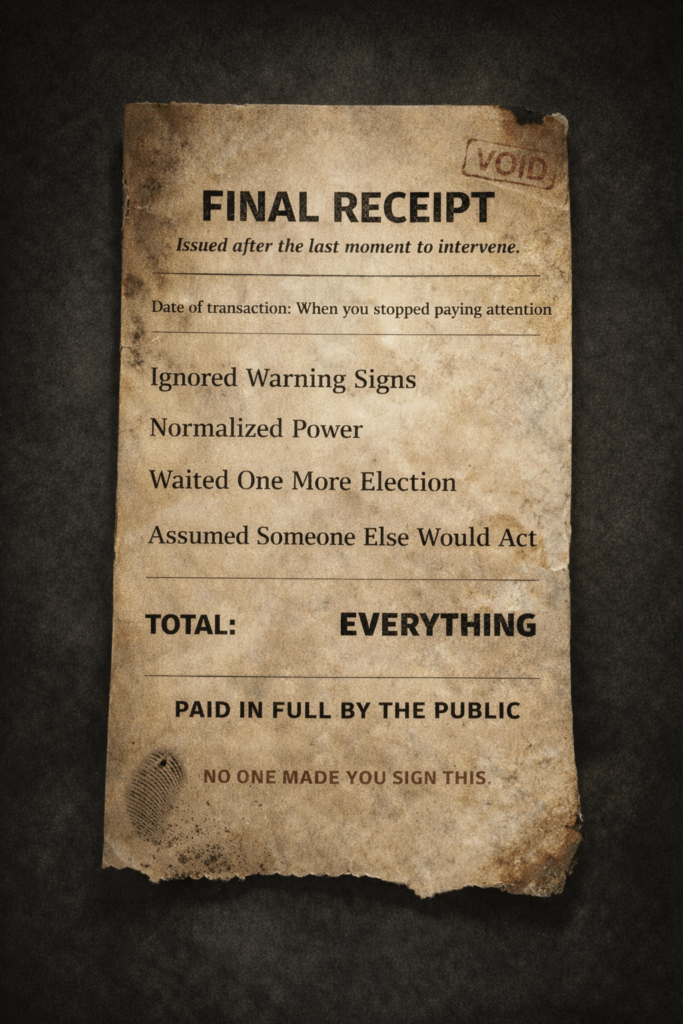
Hungary is not a prophecy. It’s a receipt.
It shows what happens when citizens wait for undeniable proof instead of acting on early warning — because the proof always arrives late. After the rules have changed. After the guardrails are weakened. After the system no longer answers to the people it was built to serve.
If Americans wait for this to feel obvious — for the moment when everyone finally agrees something is wrong — they will wake up one morning to the same realization Hungarians did:
The democracy they thought would save them is already gone.
And the moment to save it passed quietly, years earlier, while everyone was still asking whether it was really happening at all.