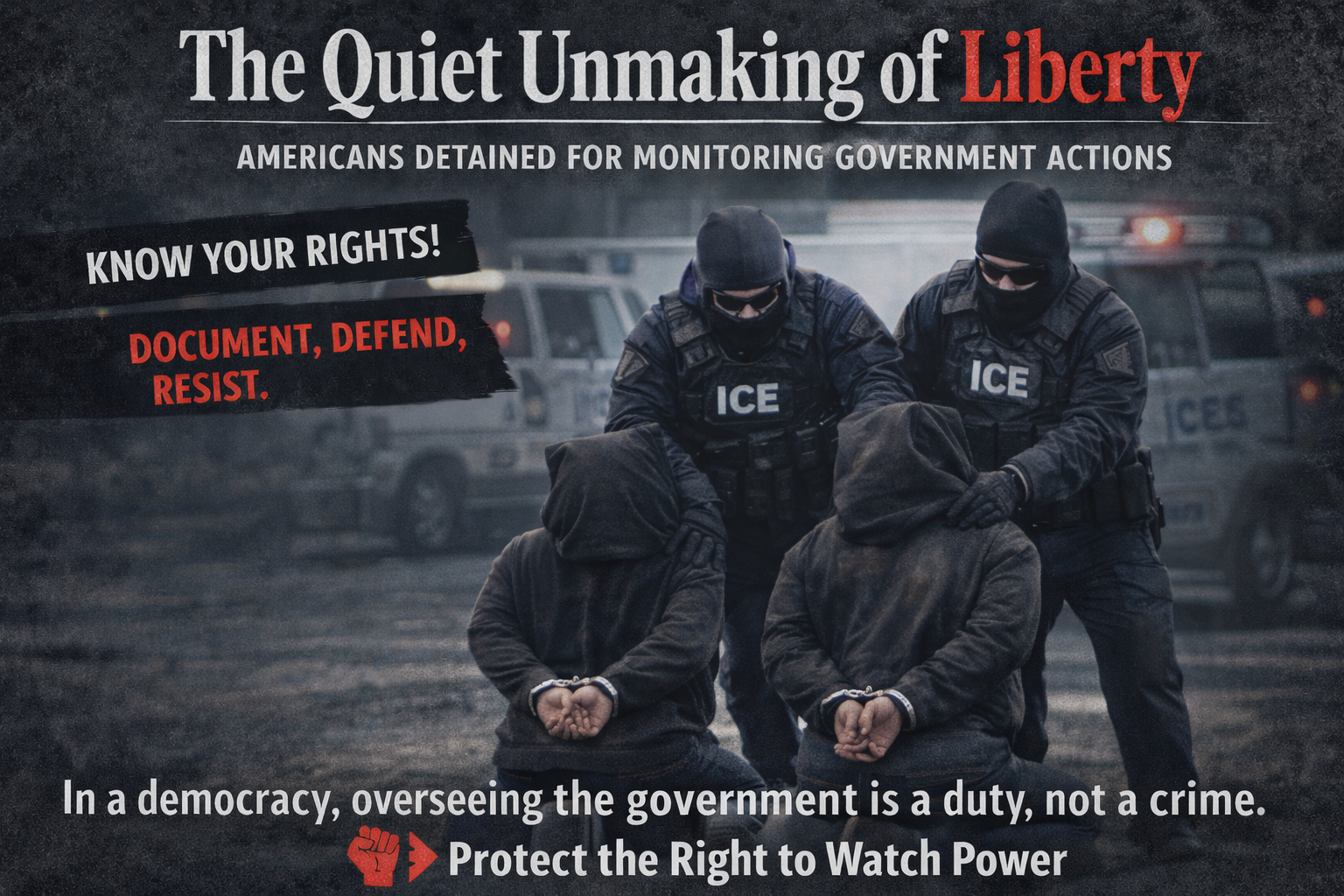
In Minneapolis last week, several U.S. citizens were detained by federal immigration officers. They weren’t accused of a crime, or even suspected of one. Their offense was quieter, subtler, and infinitely more dangerous: they were watching.
These “monitors,” as they’re called, are ordinary people who document immigration enforcement to make sure due process isn’t swallowed by fear or bureaucracy. They stand on sidewalks with notebooks and phones. They observe who gets taken, how they’re treated, and whether the law unfolds as the law is supposed to. In a healthy democracy, this makes them heroes—eyes of accountability when institutions strain under pressure.
But for a brief, unsettling moment, the government treated them as enemies.
According to reporting from the Associated Press, monitors were detained without charges, denied access to a phone, questioned about neighbors, and pressured to inform on activists. No courtroom. No hearings. No explanations. Just the machinery of the state leaning on a handful of ordinary people for daring to observe it.
That should frighten us. Not because these particular detentions will change the country overnight, but because they reveal a direction of travel: a government increasingly impatient with being seen.
Civil liberties rarely die in dramatic fashion. They don’t go down swinging to the sound of sirens and shattered glass. More often, they erode in quiet rooms and unmarked offices; in conversations not meant to be public; in the small recalibrations of what power believes it can get away with. A detention without charges here. A refusal to investigate overreach there. The line moves, almost invisibly, until one day we look up and realize the ground has shifted under our feet.
The monitors in Minneapolis weren’t just documenting arrests—they were documenting the state. And the state, it seems, didn’t like that.
Ask yourself what happens when the government can decide who gets to watch it. Democracy assumes the answer is “everyone.” Authoritarianism prefers “no one.” The difference between those two positions is not abstract. It’s the difference between a public that can scrutinize power, and a public that must take the word of power on faith.
When citizens are pressured to inform on activists, the message is unmistakable: private conscience is a threat; community is a threat; association is a threat. History teaches us that regimes don’t start by silencing speech—they start by mapping it. Who knows whom. Who attends meetings. Who keeps watching after the government asks them not to.
Whether one supports or opposes current immigration policy is almost beside the point. You can believe in firm borders, strict enforcement, and lawful deportations—and still recoil at the idea that federal agents detain legal observers for documenting government actions. Because if immigration enforcement becomes exempt from civilian oversight, what else could follow?
And yet, if this moment teaches us anything, it’s that power doesn’t only retreat when forced. Sometimes it retreats when watched. Peacefully. Patiently. Relentlessly.
The monitors in Minneapolis didn’t bring weapons or slogans or fury. They brought notebooks and phones and the stubborn conviction that a government should never fear being seen by its own people. That is a quiet kind of courage, but it is the kind democracies are built on.
There are ways to fight what feels like encroaching darkness without becoming part of it. We fight by bearing witness, by documenting, by knowing our rights and insisting that others know theirs too. We fight through lawyers who file motions, journalists who ask inconvenient questions, organizers who keep showing up, neighbors who refuse to look away.
None of this is dramatic. None of it is fast. But it works—because it forces power to admit that the public is not an audience, but a participant.
If the government seeks to narrow the space in which citizens can watch, then the peaceful answer is not to shrink, but to fill that space with more eyes, more notebooks, more cameras, and more citizens who understand that oversight is not confrontation. It is citizenship.
We do not need to shout to be heard. We only need to look—openly, unapologetically, and together.
Because a government watched by its people must remember it serves them. And when citizens refuse to stop watching, that simple act becomes its own quiet form of defense.