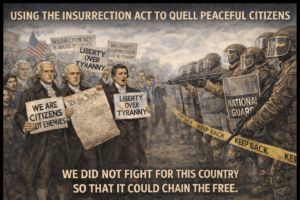
Right now, as demonstrations continue in Minneapolis following the killing of Renee Good during a federal immigration raid, the White House is openly threatening to invoke the Insurrection Act of 1807 — a law that gives the president power to deploy U.S. military forces against civilians on American soil without the consent of state government.
For a country that claims to prize liberty, that should stop us cold.
The Insurrection Act exists for scenarios in which civilian authority has collapsed so completely that the only functioning institution left is the military. That is not the reality in Minneapolis. Local officials have repeatedly urged peaceful protest and have explicitly rejected military intervention. Yet the federal government is hinting that public dissent itself is now dangerous enough to justify troops.
If the government can redefine protest as insurrection today, what stops it from redefining other forms of civic participation tomorrow?
This is not just about Minneapolis. It is about the idea that dissent is part of citizenship, not a threat to it. The Constitution was built with the assumption that the public would sometimes challenge the state — loudly, inconveniently, and in the streets. The First Amendment does not exist for polite opinions whispered among friends. It exists for the moment a citizen decides to look power in the face and say “No.”
Turning soldiers against citizens in that moment tells us something chilling: the government no longer sees citizen participation as an essential ingredient of democracy, but as a disorder to be controlled.
And make no mistake — invoking the Insurrection Act would not just be symbolic. It would put multiple freedoms under immediate pressure:
✦ Freedom of Speech When dissent becomes grounds for deployment, speech moves from protected to precarious. Citizens begin to wonder not whether they may speak, but whether it is wise to.
✦ Freedom of Assembly The right to gather publicly is older than voting in this country. It is the method by which Americans have demanded abolition, suffrage, civil rights, labor protections, and accountability. It is not a luxury. It is the furnace of democracy.
✦ Due Process Military policing is not built for civilian rights. The logic of war is not the logic of courts. Once troops are in the streets, constitutional protections become negotiable at best.
✦ State Autonomy By threatening to override state leadership, the federal government isn’t just escalating force. It is rewriting the balance of power that keeps Washington from becoming unanswerable.
Civil liberties do not erode all at once. They erode when the government discovers it can justify exceptional measures under the banner of “order,” “security,” or “emergency” — and the public decides not to resist because the threat feels distant, urgent, or temporary.
But temporary powers have a habit of becoming permanent. And emergency measures have a habit of being repurposed.
Today, the emergency is protests. Tomorrow, it could be strikes, boycotts, sit-ins, vigils, or whistleblowing. We have lived through generations of Americans who forced this country to evolve through disruption. Without them, we do not get abolition. We do not get women’s suffrage. We do not get civil rights. We do not get marriage equality. We do not get press investigations that exposed corruption, abuse, or war crimes.
If we normalize the idea that democracy can be protected from disruption by soldiers, then we are not protecting democracy. We are embalming it.
This moment demands urgency not because troops are already in the streets, but because the government is signaling that it believes it has the authority — and perhaps the obligation — to put them there.
That is how freedom fades: not when the tanks arrive, but when the public shrugs at the possibility.