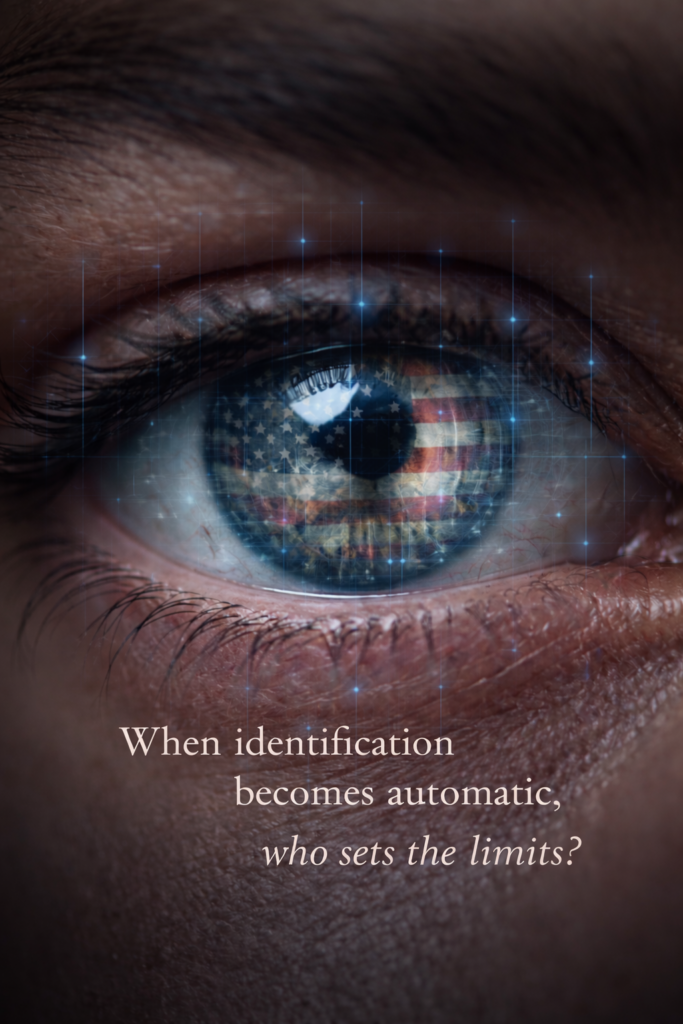
The quiet expansion of biometric surveillance in America
There was a time in this country when being in public meant something simple: you were seen, maybe noticed, but not cataloged. You could walk into a store, attend a church service, stand in a crowd at a parade, and leave without your identity being permanently recorded somewhere in Washington.
That assumption is quietly changing.
The Department of Homeland Security is developing a unified biometric search system that would allow agencies to search faces, fingerprints, iris scans, and potentially even voice data across departments. Instead of separate databases scattered across government offices, the goal is to make them searchable through a single, integrated tool.
In plain terms: one system capable of identifying people across multiple federal agencies.
Supporters say this improves efficiency. It can help solve crimes faster, identify fraud, track threats, and prevent abuse of government programs. Most Americans want law enforcement to have the tools it needs to protect the public. Safety matters.
But efficiency and safety have never been the only American values at stake.
The Constitution was written with a deep suspicion of concentrated power. The Founders had lived under a government that used “general warrants” — broad authority to search without specific cause. That experience shaped the Fourth Amendment, which protects citizens against unreasonable searches and seizures.
The point wasn’t to make government weak. It was to make it restrained.
A centralized biometric search tool raises an uncomfortable question: What counts as a “search” in a world where your face can be scanned automatically in public? If the government can instantly match you across databases — without a warrant, without your knowledge — where does oversight begin and end?
This isn’t about party politics. It isn’t about one administration. It’s about capability.
When a government develops the ability to identify anyone, anywhere, at any time, that capability does not disappear. It becomes infrastructure. And infrastructure tends to expand.
What makes this moment different is how quiet it feels. There hasn’t been a national debate. No prime-time speeches. No major vote in Congress asking Americans whether they want a unified biometric system tracking faces and fingerprints across agencies. It’s happening through development plans, procurement processes, and internal modernization efforts.
Democracies don’t usually change through dramatic announcements. They evolve through normalization.
There are real arguments on the other side. Biometric systems can catch criminals who might otherwise slip through the cracks. They can reunite missing children with families. They can reduce identity fraud. These are serious benefits.
But serious benefits require serious guardrails.
Who can access the system?
What oversight exists?
Are warrants required?
Can the data be shared with state agencies?
How long is it stored?
Can mistakes be corrected?
Facial recognition systems have already been shown to produce false matches. Errors in a unified database could affect jobs, travel, or even freedom. The more centralized the system, the greater the consequences of mistakes — or misuse.
There is also a deeper cultural question. If every public appearance can be logged and matched, does anonymity in public life still exist? Does knowing you can be identified instantly change how freely you speak, gather, or associate?
The First Amendment protects speech. The Fourth protects privacy. Together, they create space for citizens to live without constant monitoring. That space has always been part of what made America different — the idea that the government doesn’t automatically know everything about you.
Technology moves faster than constitutional reflection. Tools are built before society decides how they should be limited. That doesn’t make the technology evil. It makes the moment important.
The real issue isn’t whether government should have modern tools. It’s whether those tools have clear, enforceable limits grounded in constitutional principles.
Freedom isn’t only about what you’re allowed to say. It’s about the quiet understanding that you can move through your own country without being permanently recorded by default.
The question before us isn’t dramatic. It’s steady and serious:
In building systems that can recognize us anywhere, are we also building the boundaries that keep power accountable?
Because once a capability becomes normal, it rarely goes backward.