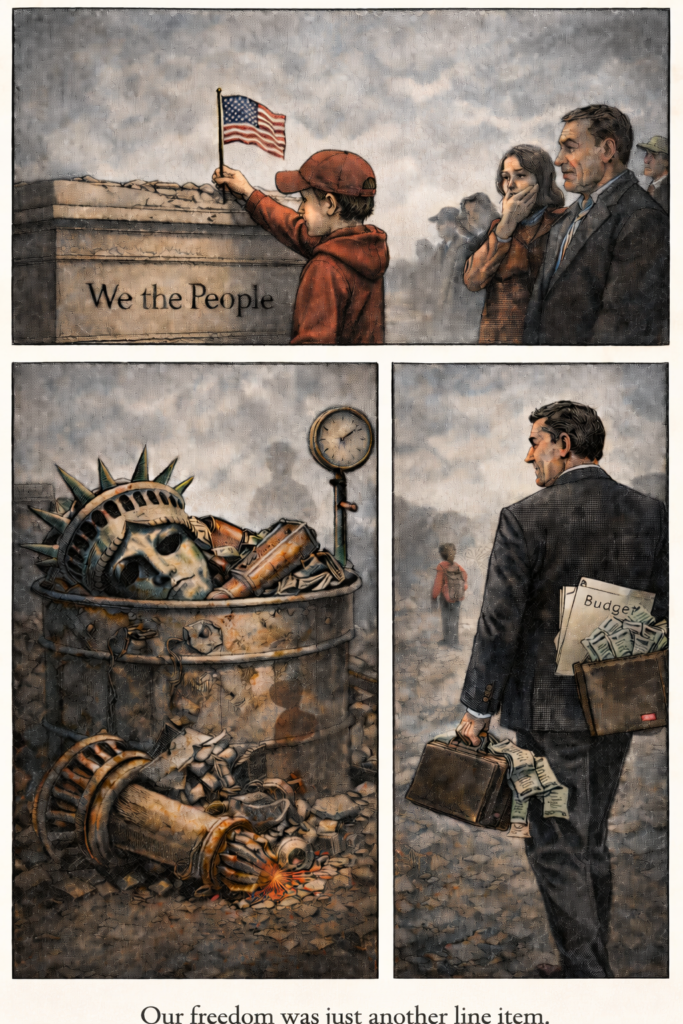
The other day I heard a kid ask his dad what freedom means.
It’s one of those questions that sounds easy until you actually try to answer it.
You want to say something simple. Something solid. Freedom means you can speak your mind. It means you can worship how you want. It means the government answers to the people. It means no one is above the law.
That’s what most of us were taught. And for a long time, we didn’t think twice about it. Freedom wasn’t fragile. It wasn’t something you assumed could be adjusted depending on the political season. It just felt permanent.
Lately, though, that permanence feels less certain.
Not because anyone declared an end to it. Not because there was a single dramatic moment that changed everything. It’s subtler than that. It’s the creeping sense that something once treated as sacred is now treated as negotiable.
You can hear it in the language.
“Necessary trade-offs.”
“Budget constraints.”
“Strategic compromises.”
All of it sounds reasonable. Responsible, even. Government isn’t simple. Resources aren’t endless. But somewhere in those conversations, freedom started showing up as a variable. Something to weigh. Something to adjust.
When did that happen?
When did the rights we used to describe as inalienable become something that could be balanced against political advantage or financial interests?
No one stands at a podium and says, “We’re selling your freedom.” It doesn’t work that way. It happens in quieter ways. In legislation shaped behind closed doors. In policy decisions that seem to benefit the same well-connected circles over and over. In campaign cycles fueled by money that most families will never see in a lifetime.
It’s not dramatic. It’s procedural.
And that’s what makes it unsettling.
Freedom doesn’t vanish overnight. It erodes when decisions revolve less around principle and more around profit. When influence follows the money. When access is something that can be purchased. When protecting the public slowly takes a back seat to protecting power.
You can feel it in the way people talk now. There’s more cynicism. More shrugging. More “that’s just how it works.”
That shift might be the most dangerous part.
Once people begin to believe everything has a price, they start to assume their voice does too. That it matters less unless it’s backed by money. That the real decisions are made somewhere else, in rooms they’ll never enter.
And kids notice that.
They don’t follow committee hearings. They don’t track legislative language. But they watch tone. They hear the sarcasm when adults mention Congress. They sense the frustration. They absorb the idea that the system isn’t really built for them.
If freedom becomes just another line in a budget — another calculation, another exchange — it changes how the next generation understands it. It stops being a birthright and starts looking like a commodity.
That’s not the country most of us believed we were passing down.
This nation has always survived disagreement. We’ve argued fiercely before. That isn’t new. What feels different is the quiet shift in priorities — when the first question becomes less “Is this right?” and more “Does this benefit us?”
When that happens often enough, people stop expecting better. They lower their standards. They accept trade-offs they would once have rejected.
Freedom shouldn’t be a transaction. It shouldn’t be something that rises and falls with campaign donations, political leverage, or backroom deals.
It should be the one thing we agree is off limits.
If we’re honest, that line feels blurrier than it used to.
And that’s worth thinking about — especially when a child asks what freedom means, and we realize the answer doesn’t feel quite as steady as it once did.