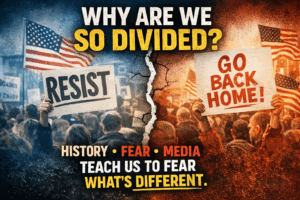
People often complain that Americans are quick to dislike or distrust those who are different from them—whether that difference is political, cultural, racial, or simply a matter of personality or values. It’s an interesting contradiction: the U.S. celebrates diversity, yet routinely struggles with it. The reasons aren’t uniquely American, but the country’s history and media environment tend to make the problem more visible.
Psychologists point to a basic human habit: we sort people into groups. Social Identity Theory (Tajfel & Turner, 1979) explains that being part of a group boosts our self-esteem and sense of belonging. The flip side is that when our group feels threatened, we push away outsiders. This helps explain why politics in the U.S. has become so emotionally loaded. Political identity isn’t just about policies anymore—it’s part of who people are.
Another layer comes from implicit bias, which refers to assumptions or stereotypes that influence our judgments without us realizing it. Research by Banaji and Greenwald (1995) shows that implicit biases can shape reactions around race, gender, and culture, even among people who believe in fairness and equality. These unconscious reactions can make unfamiliar groups feel risky or untrustworthy, leading to faster negative opinions.
History plays a big part too. The U.S. grew out of waves of immigration, conflict, racial hierarchy, and ideological battles. Because American identity isn’t tied to one ethnicity or religion, the question of who “belongs” has always been debated (Smith, 1997). Those debates become especially tense during moments of social change.
Modern media doesn’t help. Digital platforms reward outrage and polarization because those emotions keep people clicking and sharing. Research on affective polarization finds that Americans now dislike the opposing political party at an emotional level—even when they don’t disagree on actual issues (Iyengar & Westwood, 2015; Iyengar et al., 2019). It’s not just that people see things differently—they see each other differently.
Economic anxiety adds fuel to the fire. When people feel unsure about their social or financial future, they’re more likely to blame or fear other groups. Political scientists call this status threat, meaning groups worry about losing influence or cultural standing (Mutz, 2018). Demographic change and inequality can make those threats feel more urgent.
There’s also a uniquely American twist: individualism. Americans are encouraged to “be yourself,” which can be empowering but also isolating. In cultures with stronger collective norms, differences can get cushioned by shared obligations. In the U.S., differences often collide without much buffer.
The good news is that attitudes do change. Public opinion has grown more accepting on issues such as interracial marriage and LGBTQ+ rights. But understanding the psychological, historical, and economic forces behind division helps explain why difference can feel threatening—and why fixing the problem requires more than just calling for unity.